


Lenny Antonelli is deputy editor of Passive House Plus. He also writes regularly for the Irish Times, and has contributed to a variety of other publications including the Sunday Times, the CS Monitor, Village, the Sunday Tribune amd the Dubliner. He is currently working on a radio documentary on Ireland's oceans.
EPA HQ
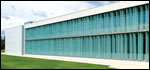
A new extension to the EPA's headquarters in Wexford lives up to the organisation's aim of environmental protection, boasting passive ventilation and lighting, a host of green technologies and a sustainable approach to landscaping.
Sustainability at the London 2012 Olympics

The Olympic Stadium, London, under construction. Photo by tompagenet .
I listened to Peter Bonfield, the chief executive of the Building Research Establishment, talking in Dublin last year about sustainability at the now-under-construction Olympic park in London. He was speaking at the annual conference of the BRE's Irish arm, and two aspects in particular impressed me: the amount of material being recycled, and the genuine efforts being made to ensure the facilities will benefit local communities in the long term - social sustainability, you might call it. For example, the upper half of the main stadium (above) is a temporary structure that will be removed after the games, ensuring it's not out of place in the surrounding community and that local people will feel comfortable using it.
Which brings me to an interesting video from the Guardian on the sustainable features of the Olympic park facilities.
If you want an alternative take on the social impact of the Olympics, read George Monbiot here and here .
How to shrink the carbon footprint of retrofit?
In an interesting new essay, she points out that replacing the world’s energy infrastructure involves “an enormous front-load of fossil fuels”, which are required to manufacture wind turbines, electric cars, new grid connections, insulation and all the rest. This could push us past the climate tipping point. Instead, she proposes, we must ask people “to make short term, radical sacrifices”, cutting our energy consumption by 50%, with little technological assistance, in five years. There are two problems: the first is that all previous attempts show that relying on voluntary abstinence does not work. The second is that a 10% annual cut in energy consumption while the infrastructure remains mostly unchanged means a 10% annual cut in total consumption: a deeper depression than the modern world has ever experienced. No political system - even an absolute monarchy - could survive an economic collapse on this scale.
Astyk's essay can be found here.
Re-reading Monbiot's piece recently, it got me thinking about how much carbon would be emitted by a massive national insulation and retrofitting effort here in Ireland - by the manufacture and transport of the materials, the vans on the road etc. I'm not for a second suggesting this work shouldn't be done - it should and must.
It's the only way to future-proof our buildings against energy insecurity and to help ensure they are responsible for producing as little carbon dioxide as possible - I'd much rather rely on a highly energy efficient building to keep energy use low than on consumer behaviour. And besides, there's an important comfort argument to be made here too - everyone would prefer a well insulated, warm home to having to reduce energy use even further in a draughty energy inefficient home.
But the question is, how do we keep the carbon footprint of retrofitting itself to a minimum? Is the key using as many locally produced, low embodied energy materials as possible? Or perhaps to ensuring batches of houses are done at the same time to ensure transport efficiency? As far as I can tell, nobody has really attempted to answer the question of how to minimise the carbon footprint of retrofitting, or done a thorough carbon audit of retrofitting work. Anyone?
Green building & energy links, May 26
Do Frank Gehry's comments on green architecture reveal a wider lack of knowledge?

Frank Gehry's Dancing House, Prague. Photo by RyanGWU82.
Renowned architect Frank Gehry caused a a bit of a stir last month during a speaking engagement in Chicago. Asked about the role of green architecture and buildings in tackling climate change, he said: "I think the issue is a political one."
He went on to criticise LEED, the US's rating system for the environmental impact of buildings, for rewarding "bogus stuff", and added that the costs of green buildings are "enormous", and that "they don't pay back in your lifetime."
Treehugger has an interesting report on the response from architecture writer Fred Bernstein, who defends Gehry's criticism of LEED, writing in ArchNewsNow:
One example is CityCenter, the Las Vegas complex that contains more than 5,000 hotel rooms, plus casinos and shopping malls and restaurants and nightclubs - altogether, 18 million air-conditioned square feet smack in the middle of the Mojave Desert. I can't imagine a greater environmental disaster than this complex (which, in addition to requiring vast resources to build and operate, is designed to draw travelers from around the world). And yet it was awarded LEED Gold status.What I found most interesting was Gehry's claim that the costs of green building are "enormous" - this is patently untrue. Construct Ireland has published numerous articles over the years that prove green buildings - or at least buildings that are quite green - can be built at little extra cost (see this project for example). Consider the mixed-use complex in Foxrock we featured in the March issue of the magazine, which will be online shortly. It's built to an almost-passive energy standard and makes abundant use of green materials, but Seamus O'Loughlin of contractors Viking House told us his price was the same as that offered by conventional builders - who were planning to build to the 2005 energy standards - who also bid for the project.
Gehry has designed some of the most iconic buildings of our times, but I think his comments are reflective of a wider lack of understating among many architects when it comes to green building and architecture. Of course some have been building green properly for a long time, but many have only started to talk about sustainability as the term has become trendy in the last five years or so. While some have genuinely made the effort to educate themselves, others haven't and just throw the lingo around. I've spent hours browsing architects' websites looking for potential case studies for Construct Ireland, and though many talk a lot about sustainability and energy, when you get to the details they usually reveal a lack of in-depth knowledge about what green building really is. In fairness to Gehry, at least he isn't pretending to be green when he isn't.
Irish business leaders back green procurement

A new coalition of Irish business leaders has issued an open letter urging the government to leverage the State’s €17bn annual procurement spend to develop the green economy.
The CEOs and managing directors of companies including Siemens Ireland, Airtricity, Ecocem, Glen Dimplex and Bord Gais have signed up to Green for Growth, a coalition calling for the state to commit to buying greener goods and services to keep Ireland competitive domestically and internationally.
Green building & energy links, May 11
Knock yourselves out:
US group offers to meet Ireland's wave energy targets: Irish Times
OMA Architects has created an ambitious proposal for a European-wide power network that it claims would reduce the conintent's carbon emissions by 80% by 2050. Check out a fascinating image gallery of the design here: Guardian
The Emilio Ambasz Prize for green architecture, top three: ArchDaily
Bill Gates donates $300,000 to cloud-seeding geo-engineering technology: The Times
Slideshow - the greenest of the winners of the Canada governor general's medals in architecture: Treehugger
Short profile of a passive house in the Wisconsin Woods: Green Building Advisor
Will fly ash be classified as a hazardous waste by the US Environmental Protection Agency: Green Building Law Update
The Monte Rosa hut
I've been keenly waiting to see the finished Monte Rosa Hut in Swtizerland since I saw the first design illustrations, and the building is now finally finished. This Swiss mountain hut, a five-storey timber frame building on steel foundations, is designed to be 90% energy self-sufficient - it boasts an 85 square metre solar PV array with excess energy stored in "lead-acid accumulators". There's more details here and here. Photos courtesy of ETH-Studio Monte Rosa/Tonatiuh Ambrosetti.


A random selection of beautiful buildings
The American Institute of Architects' ten green buildings of the year
Last week the American Institute of Architects announced its top ten green building projects of 2010. Pictured below is one of the buildings, the Omega Centre for Sustainable Living in New York. Jetson Green has a gallery of all the buildings, while detailed information on all of the projects can be found here .

Photo by Andy Milford