Ambitious companies in the Irish sustainable building sector should look to the US, says Century Homes founder Gerry McCaughey. As chief executive of LA-based green building business consultancy Infineco, McCaughey is witnessing first-hand how the land of opportunity is waking up to green construction
It has been nearly three centuries since the last American Revolution. It was a time of great political upheaval as the fledgling colonies began to assert their coming of age. Well, since early 2009 America or more appropriately the United States has begun to experience a second revolution – the US green revolution – which in many ways may have as much, if not more far-reaching political effect as the first revolution.
We are all aware that under the Bush administration there was no chance that the US was going to embrace the Kyoto protocol or indeed even acknowledge that there was a climate problem. However since the Obama administration came into the White House there has been a palpable change in Washington’s attitude towards the environment. We have seen numerous bills formulated for the congress to vote on. Most notably, in June 2009 the Waxman Markey bill – also known as the clean energy bill – passed its first test in the congress. This is major victory for environmental groups in the US. The bill sets a cap on emissions of greenhouse gases. By 2020, emissions must be reduced by 17% over 2005 levels. By 2050, emissions must be reduced by 80 per cent or more.
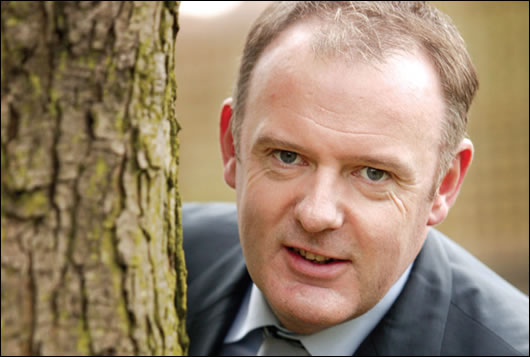
Gerry McCaughey, CEO of Infineco
In order for these targets to be met the business as usual mentality has to change, and whilst there has been a lot of talk and coverage of the gas guzzling US cars and SUVs in particular, there has been a quiet but significant revolution happening in the construction industry. Much like the construction industry in Ireland, there has been a lot of political lobbying by the large construction companies to prevent or at least minimize the effects of environment legislation on them but the tide is now firmly going against them. In California legislation was passed called AB 32 to require all new homes be zero net energy by 2020 and all new commercial buildings be zero net energy by 2030. California also passed AB 811 which allows homeowners to finance energy efficiency retrofits to their existing properties by the state issuing a municipal bond and then the homeowner paying over 20 years through their property tax. Innovative thinking like this is firmly putting US housing on a clear path to world-class energy efficiency.
Many other states are also beginning to embrace green in the built environment. In particular the western seaboard states of California, Oregon and Washington State are showing strong leadership along with Colorado in greening the built environment.
In here lies a major opportunity for Irish companies in the environmental sphere. Despite a very slow start for Ireland and mainly thanks to the Greens, Ireland now has some of the most advanced environmental building regulations. It is this first-hand experience that could bring market opportunities for innovative Irish companies in the US.
The United States residential construction market is enormous – with over 300 million people the new home market has reached over two million new homes per year, although it will be lucky to hit 600,000 this year. However this should be the bottom of the housing cycle. In fact despite the relatively low level of housing activity there is much evidence to prove that green and environmental sectors of the construction industry are doing remarkably well. According to a new study by venture capital firm Good Energies Inc, green buildings will make up about half of the non-residential building stock by 2015, up from about 15% currently. This projected rapid growth would represent a surprising change as green building was considered a small niche market only 10 years ago. McGraw-Hill Construction released a study in October of 2009, saying that the share of green building in the retrofit market could grow to 20 to 30% in the next five years, with the market opportunity for major projects growing to $10.1 billion to $15.1 billion. Currently, green building practices are used in 5 to 9% of the building retrofits currently completed, with the market opportunity for major projects – those more than $1 million in value – at $2.1 billion to $3.7 billion annually.
So the market that was once considered a laggard in green is now set to become a leader. My advice to any Irish company that is looking to maintain or grow its business is that it should seriously consider the US market. Despite all that I said above it is not an easy market to break into. It is geographically huge and in terms of environmental legislation you need in many respects to think of it as 50 separate countries. It is also a waste of time and energy to think that you can make inroads into it purely by being based in Ireland. The US is a sophisticated market and customers like to know that there supplier is committed to their market.