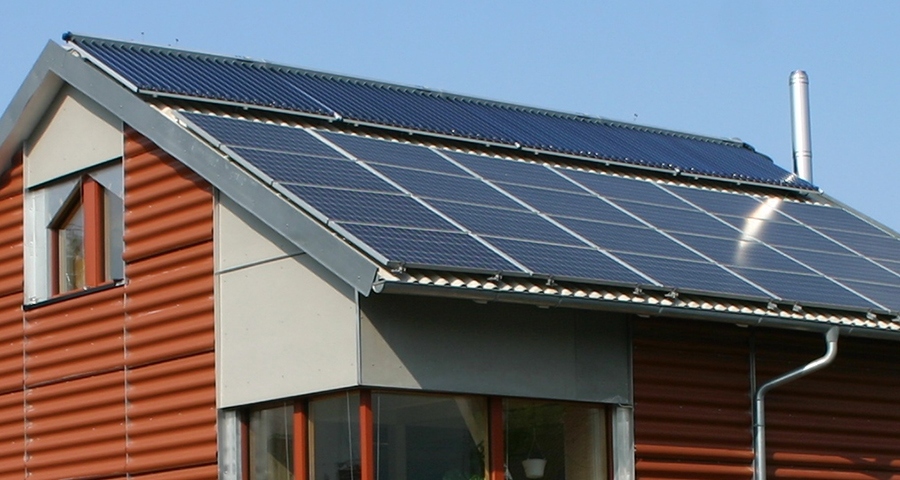
The institute's founder Dr Wolfgang Feist will present details of the new categories, which may be of significant interest to EU member states preparing to set nearly zero energy building (NZEB) standards, at the 2014 International Passive House Conference on 25 to 26 April in Aachen, Germany. Due to a key clause of the recast EU Directive on the Energy Performance of Buildings, all new buildings in the EU must by NZEBs by 2021.
“A building that produces more energy than it consumes is not only possible, it is often very sensible,” said Dr Feist, while cautionin about how such an aim is calculated. “A building that produces an energy surplus in summer doesn’t necessarily have a good energy balance. Photovoltaic systems typically yield very little energy in winter, which is exactly when the most energy for heating is used. Therefore, the calculation only works when the energy demand itself is also very low.”
Energy efficiency thus remains the basis for the passive house standard. In addition, the new classes of passive house buildings will rate the coverage of the remaining energy demand by renewable sources. Taking the example of a single family home, the new Passive House Plus label confirms that about as much energy is produced as is consumed, whereas the Passive House Premium seal denotes an energy surplus.
“The new classes view energy production in relation to the potential of the particular building in question,” emphasises Dr Benjamin Krick, senior scientist at the Passive House Institute. “A single family home built to the passive house standard can achieve an energy surplus relatively easily; for an apartment building it is much more difficult, as such buildings have a far smaller roof area available per square meter of living space. It is for this reason that the new classes calculate energy production in relation to the ground area occupied by the building.” A future-oriented scenario in which only renewable energies are used throughout the electrical grid serves as reference for the evaluation.
According to the institute, some 50,000 passive house units have been built worldwide.
For information on the 2014 International Passive House Conference visit www.passivehouseconference.org