
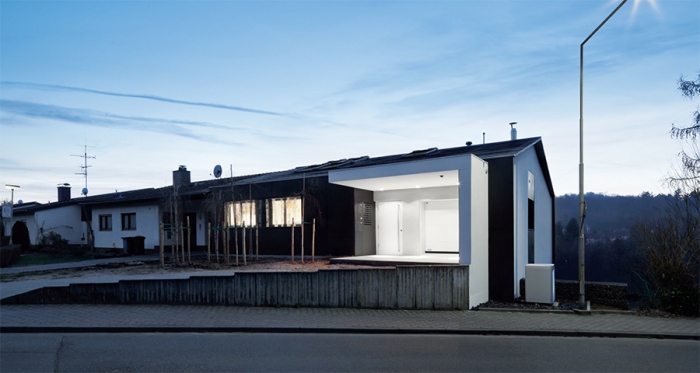
This issue’s Eurocentric selection is drawn from the International Isover Energy Efficiency Awards, including a German renovation that generates an energy surplus, a Danish nature reserve, a Romanian Solar Decathlon entry and a Polish church.
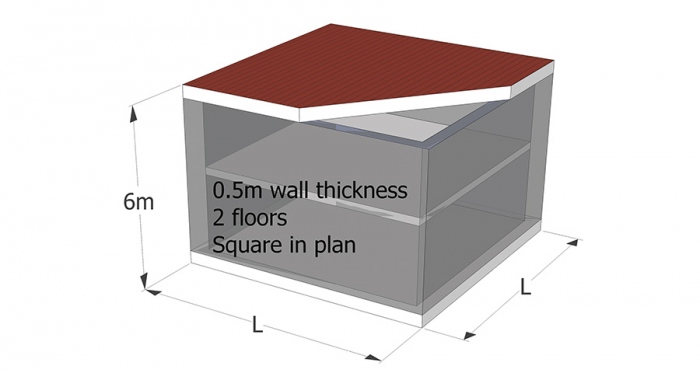
It’s sometimes said to be hard – perhaps too hard – to get a small house to meet the passive house standard. But a small house will have small heating bills, so why is it hard for a small house to be a passive house? Leading passive house consultants Alan Clarke and Nick Grant delve into the passive house software to find out what’s going on.
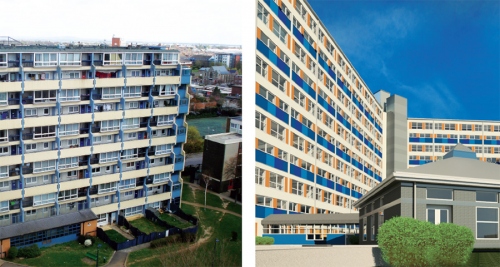
Britain and Ireland’s post-war social housing blocks are seen as ugly and uncomfortable, and suffer from high energy bills, damp and mould. But three ambitious renovation projects show the answer doesn’t always lie in demolition.
Deep retrofit brings Victorian home up to Enerphit
Written by Lenny Antonelli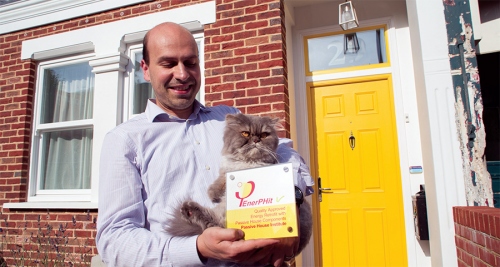
There was a time when insulating an historic property meant treading lightly on its building fabric. But today, guided by building physics, passive house designers continue to push the boundaries of retrofit by bringing old homes up to modern standards of super-insulation. This project is the third such deep retrofit to an historic London property by Green Tomato Energy.
London upgrade future proofs historic building
Harry Paticas, Alan Clarke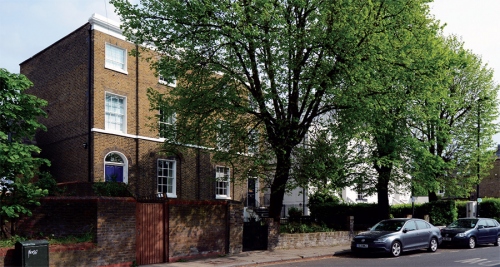
The general consensus is that it’s not appropriate to upgrade historic buildings to avant garde energy efficiency levels, creating a sense that conservation of the natural and built environments may be mutually exclusive concerns. Not so, argue Arboreal Architecture’s Harry Paticas and passive house engineer Alan Clarke in an updated version of a paper presented at the 2014 International Passive House Conference, about a highly experimental upgrade to a London townhouse that may point to a sustainable solution.
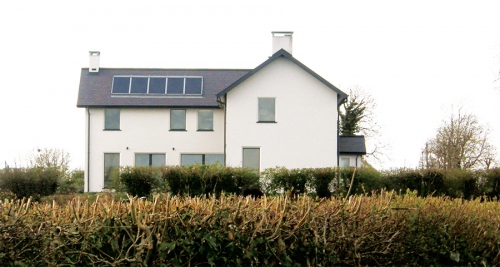
For self-builder James Byrne, building to the passive house standard was just one element of an approach that aimed to drastically reduce the environmental impact of his house — built from a hemp and lime system, it also features solar collectors, rainwater harvesting and natural wastewater treatment.
Despite its stop-start beginnings, this cottage in the west of Ireland delivers a traditional-but-stylish design with close-to-passive performance.
Sideways West Cork house rests lightly on the land
Written by Lenny Antonelli
This uncertified passive house on Ireland’s south-west coast makes a striking-yet-sensitive architectural statement.
Rural Durham home mixes thoughtful design and passive aims
Philip Newbold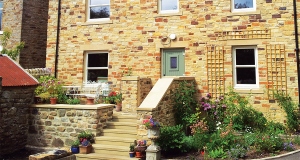
Architectural technician Phillip Newbold overcame strict planning rules and a tight budget to build his sensitively designed, super low energy home in an area of outstanding natural beauty.

The team behind a series of passive house schools in Wolverhampton have used the lessons learned from in-depth monitoring of the first two buildings to make the third even better — and cheaper to build.
More...

This year’s international Passive House Awards featured 21 projects — out of about 100 entries — across six different categories, with shortlisted projects coming from across Europe plus New Zealand, South Korea, and the United States. In this issue’s international section, we pick four buildings from an exceptional selection.

Such is the importance of ventilation, it’s only right and proper that the efficacy of innovative mechanical solutions such as heat recovery ventilation and demand controlled mechanical extract ventilation is established
based on robust, comprehensive evidence. But how does natural ventilation fare when subjected to the same degree of scrutiny, and can it work in low energy buildings?
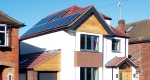
Tina Holt had experience advising homeowners on energy efficiency, so when she wanted a low energy home, buying a run-down 1950s dwelling and aiming to turn it passive was an obvious step. She tells her own story below.
Victorian upgrade hits 80% energy saving
Written by Lenny Antonelli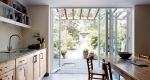
Most energy upgrades to historic homes in architectural conservation zones take a fairly gentle approach to insulation and airtightness — this one did the exact opposite.