
Gormley launches government architecture policy
Written by Lenny Antonelli

Environment minister John Gormley yesterday published the
government's policy on architecture for 2009 to 2015, titled Towards a
Sustainable Future: Delivering Quality Within the Built Environment.
The Guardian yesterday reported that the UK Conservative Party's plans for a "green deal" include a Pay As You Save proposal that would allow householders to receive energy upgrades at no up front cost and pay for the work over time through their bills.
Alok Jha reports from a speech by Tory enegy and climate spokesperson Greg Clark:
Every UK homeowners will benefit from an allowance of up to £6,500 to make their properties more energy efficient, under a "green deal" proposed by the Conservatives today. The idea is part of a wider energy and climate change package aimed at kick-starting a green economy in the UK...
...Heating and powering homes accounts for 27% of the UK's overall carbon emissions and, speaking this afternoon, Clark set out how the green deal would aim to reduce this total. The money, to be sourced from the private sector, would not be given to householders directly; instead, energy companies or charities would insulate homes at no cost to residents and then recoup the money through energy bills. As the new insulation would reduce energy use, this should not result in extra costs for the homeowner.
This does beg the question though - just how much of an energy improvement can you make to the average home with £6,500?
Some random links for you to peruse:
An interesting-looking series of podcasts on the theme of building science: Green Building Advisor
Should buildings be designed like letters? Article on finding the right balance between minimising surface area for heat loss and maximising it for natural light and ventilation. Treehugger
Six clever 'green' products in the pipeline: Jetson Green
Dow unveils solar PV roof shingles: Jetson Green
An article on careers in sustainable design and engineering: Guardian
US survey shows builders don't tell buyers about green features in their homes: EcoHome magazine
SEI announces funding for Irish ocean energy companies
Written by News Desk

Ten Irish companies developing ocean energy technologies will share
e4.3millon in funding from Sustainable Energy Ireland (SEI), the
national energy authority announced yesterday.
Ireland ranked fourth in the world for wind power
Written by Lenny Antonelli

Ireland now ranks fourth in the world for the contribution of wind
energy to electricity use, according to the International Energy
Agency's 2008 Wind Energy Annual Report.
Comhar report proposes massive "green new deal"
Written by Lenny Antonelli

SPENDING ON the smart economy should be increased eightfold to
almost e4 billion a year to make Ireland a world leader in creating
green collar jobs, according to the national advisory body on
sustainable development.
In a report on a “Green New Deal” for Ireland published yesterday, Comhar argued that a multi- billion euro commitment would be needed if Ireland was to become a sustainable, low-carbon economy.
Construct Ireland campaigns to energy upgrade Ireland
Written by Jeff Colley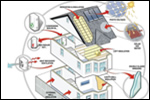 Construct Ireland has launched a campaign calling for the introduction of pay as you save (PAYS), a system with the potential of substantially energy upgrading the Irish building stock. PAYS overcomes obstacles to the en masse uptake of energy investments such as the requirement for upfront capital, unease at signing up to debt in the case of loans, and lack of confidence in the suitability of particular measures and technologies in a given building.
I blogged a few days ago about Mick Williams's campaign for a boiler scrappage scheme in the UK that would offer money to householders to replace their old boilers with new, high efficiency units.
A somewhat similar scheme is about to kick off in the US. The US Department of Energy's Cash for Appliances programme will fund rebates to consumers purchasing energy efficient appliances, and is backed by $300m of funding. The new appliances must be certified by the US Environmental Protection Agency's Energy Star program - an award mark for energy efficient appliances. Individual states will decide which appliances are eligible, and the level of rebate. The Department of Energy has recommended they focus on heating and cooling equipment such as heat pumps, boilers, washing machines, dishwashers, fridges and freezers.
Unlike the proposed boiler scrappage programme and "cash for clunkers" car scrappage schemes, there is no requirement to trade in old appliances. Rebates are expected to be between $50 and $200.
Turning straw waste into building beams: Inhabitat
Global oil reserves and fossil fuel consumption: Guardian data blog
Twenty 'solar-powered' homes compete at solar decathlon: Jetson Green
New Hampshire home lands coveted LEED Platinum certification: Green Building Advisor
Two Dublin buildings win major architectural awards: Irish Times
Using waste plastic as a cement aggregate: Inhabitat
Nicholas Stern optimistic about climate change talks: Guardian
EPA chief calls for urgent action on green economy
Written by News Desk

IRELAND CANNOT afford to wait before investing in the green economy,
the director general of the Environmental Protection Agency (EPA) has
said.
Speaking at the organisation’s annual conference, Mary Kelly said there were significant economic opportunities for Ireland in becoming a low-carbon and greener economy.
More...
80% of homeowners want energy upgrade through utility bills
Written by News Desk
80 per cent of Irish homeowners would be interested in paying for comprehensive energy upgrade work through a repayment tariff on their utility bills, a survey has found.
The results, from the monthly online omnibus for August by leading market research consultancy Amárach Research, coincide with the launch of a Construct Ireland campaign calling for energy upgrades across Ireland’s building stock through energy suppliers.
Witold Rybczynski's "green case for cities"
Written by Lenny AntonelliWriting in US monthly The Atlantic, architect Witold Rybczynski outlines his "green case for cities", arguing that there is too much focus on flashy green gadgets and not enough on practical building methods:
Putting solar panels on the roofs doesn’t change the essential fact that by any sensible measure, spread-out, low-rise buildings, with more foundations, walls, and roofs, have a larger carbon footprint than a high-rise office tower—even when the high-rise has no green features at all.
He also has a pop at the media for encouraging the "green gadget" trend:
Architectural journals and the Sunday supplements tout newfangled houses tricked out with rainwater-collection systems, solar arrays, and bamboo flooring. Yet any detached single-family house has more external walls and roof—and hence more heating loads in winter and cooling loads in summer—than a comparable attached townhouse, and each consumes more energy than an apartment in a multifamily building. Again, it doesn’t really matter how many green features are present. A reasonably well-built and well-insulated multifamily building is inherently more sustainable than a detached house. Similarly, an old building on an urban site, adapted and reused, is greener than any new building on a newly developed site.
Rybczynski leaves his most important point to the end, suggesting the future could be developments that are "dense without being vertical". He cites Montreal as an example of city where the dominant form of housing is a three or four-storey apartment block that doesn't require elevators.
Rybczynski makes a good point - while high rise is often touted as the solution to unsustainable urban sprawl, tall buildings typically require elevators, artificial ventilation (due to increases wind speeds and noise associated with openable windows at height) and heavy, high embodied energy structural components - perhaps three or four storey "walk ups" represent an ideal compromise.
But without solid figures, it's impossible to be sure. Does anyone know of any studies out there examining the energy footprint of different building forms?
Does a boiler scrappage scheme make sense?
Written by Lenny AntonelliI saw this in the Guardian yesterday - leading UK environmentalist Tony Juniper encouraging the British government to introduce a boiler scrappage scheme. Such a scheme would offer householders grants to replace their old boilers with new, high efficiency ones. It would work similarly to the UK car scrappage that offers money to those trading old cars for new ones.
Juniper writes:
The simple idea is that by replacing the country's old, inefficient gas boilers it would be possible to achieve a major environmental benefit and conserve a valuable resource while at the same time creating employment and economic activity...
...Reheat Britain suggests that a limited and temporary fund is created, mostly from public sources but perhaps also including contributions from boiler manufacturers. It would work along similar lines to the car scrappage scheme, and it is estimated that an incentive of about £200 per boiler would be needed.
Juniper says that replacing a G-rated boiler with an A-rated condensing boiler with better controls could cut household energy bills by a quarter. He says that the carbon cost of making and fitting new boilers would be quickly compensated for by the high efficiency of new, A-rated units.
He also speculates that the idea could be slow getting approval in political circles because of the absence of lobbying power in the heating sector compared to the motor industry.
A boiler scrappage scheme is a sensible idea, but might not be necessary if governments adopted a pay-as-you-save scheme that would enable householders to energy upgrade their homes (with measures including new boilers) at no up front cost, and repay the work over time on their utility bills.Cities have the potential to store vast amounts of carbon, according to a new study. National Geographic reports on the work of Galina Churkina of the Leibniz Centre for Agricultural Landscape Research in Germany:
Churkina and colleagues pulled together previous evidence looking at various stores of organic carbon—carbon that comes from living things, as well as from such as plants and animals, wood, dirt, and even garbage.Of all the urban carbon, about three billion tons are locked up in man-made materials - two thirds in rubbish dumps and the rest in building materials like wood. The story continued:
Cities—including both dense metropolises and sprawling suburbs—store about a tenth of all the carbon in U.S. ecosystems, the study estimated.
In total, U.S. cities contain about 20 billion tons of organic carbon, mostly in dirt, according to the new study to be published in an upcoming issue of the journal Global Change Biology.
Many cities have already launched ambitious plans for turning gray to green, such as Los Angeles' Million Trees LA project, which aims to plant a million trees in the Californian city over several years.
Building timber instead of concrete houses could also help to sequester carbon, said Leif Gustavsson, an expert on green technology at Mid Sweden University. But he said the main carbon benefit is from the embodied energy of the construction itself, rather than carbon stored in the material.
Meanwhile, earth scientist David Pataki of the University of California stressed that getting urban soils to store more carbon would be a careful balancing act. "Managing urban soils to store more carbon can use energy, and those fossil fuel emissions have to be taken into account," he told National Geographic.