

In this first instalment of his brand new ‘Help Desk’ feature, architect and passive house designer Simon McGuinness of Dublin Institute of Technology invites questions on all aspects of passive house, retrofit and low energy building.
SuperHomes scheme: a blueprint for cost-effective deep retrofit?
Written by John Cradden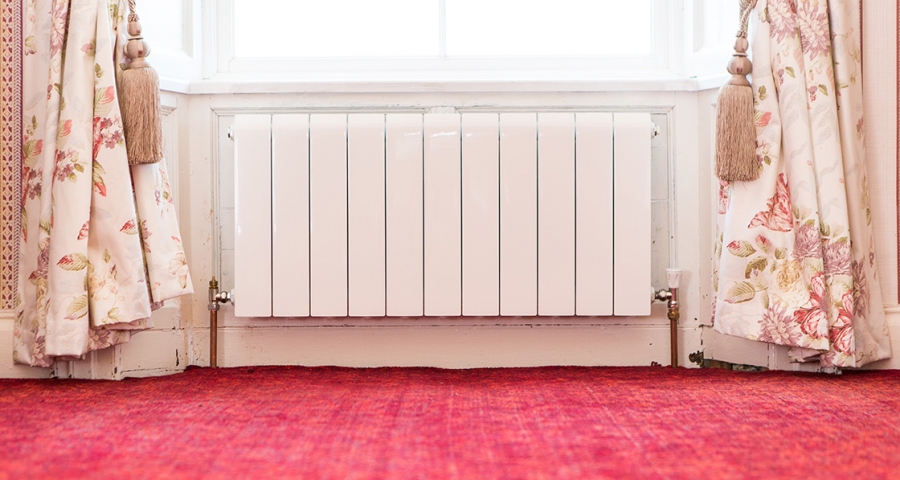
For a while now, schemes that aim to encourage the mass uptake of home energy upgrades — essential for cutting carbon emissions from our building stock — have tended to fall into two camps: those that focus on shallow measures like cavity wall insulation and new boilers, and deep retrofit like the Passive House Institute’s Enerphit standard. A new Irish retrofit scheme aims to point the way forward by bridging the gap between these two extremes.
Solihull upgrade trials revolutionary retrofit approach
Written by Ben Adam-Smith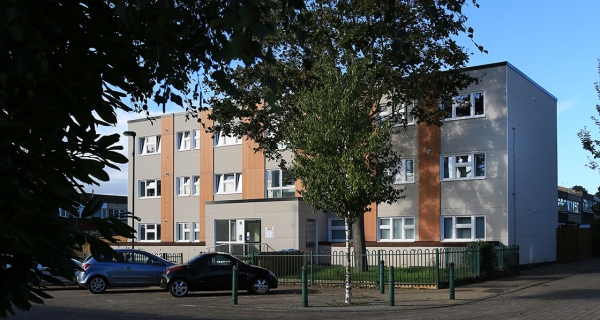
An exciting and innovative new deep retrofit project in Solihull has drastically cut the energy consumption of a small block of flats by smoothly and efficiently wrapping the entire structure in both insulation and ventilation ducting, delivering huge energy savings and minimal disturbance to the residents.
Deep retrofit transforms big, complex South Dublin home
Written by John Hearne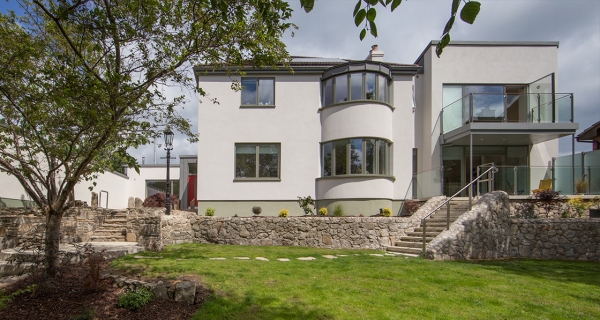
At first glance, this sprawling house in Blackrock would appear to be a nightmare candidate for a deep energy upgrade — large and sprawling, and with a mix of structures built at different times and with different materials. But guided by the passive house standard, the team behind it managed to turn a G-rated energy guzzler into a healthy and very-low energy family home – complete with an A rating.
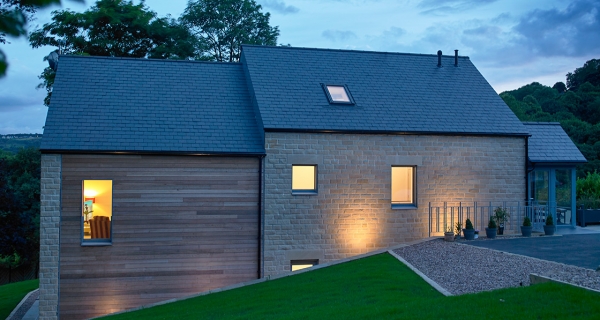
Green Building Store continues to fine tune passive house design and construction techniques with exacting attention to detail, as demonstrated by its latest superinsulated, stone-clad cavity wall house in West Yorkshire.
UK's largest passive building opens to 2,400 students and staff
Written by Kate de Selincourt
Completed early this year, the new Centre for Medicine at the University of Leicester is by far the largest single building in the UK to meet the passive house standard — and not surprisingly, its design and construction posed tough new challenges for how to meet the rigorous low energy standard on such a large, complicated building.
Ground-breaking housing scheme captures one developer’s journey to passive
Written by John Hearne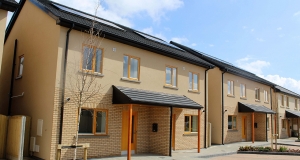
The just-finished second phase of Durkan Residential’s ambitious Silken Park scheme in south-west Dublin bridges the gap between two extremes: while phase one was built to the 2002 building regulations, phase three — which will break ground next year — will comprise 59 passive certified units.
BREEAM excellent building marries sustainability with world-class design
Written by Ekaterina Tikhoniouk
Although Ireland’s energy efficiency requirements for non-residential buildings fall far short of EU requirements, occasionally a progressive client will take matters into their own hands and push the envelope of sustainable design, such as Gas Networks Ireland’s award-winning Finglas offices.

This issue features the world’s smallest certified passive house in France, and the first certified passive house on New Zealand’s South Island.
Zero Hour: Industry out of time on profound imminent NZEB changes
Written by Jeff Colley
The construction industry is unwittingly facing the prospect of immediate, dramatic changes to how buildings are designed and constructed to comply with imminent EU energy efficiency deadlines. In the first article in our new Dispatches section – where we’ll attempt to probe and investigate in detail the burning issues arising from Ireland’s transition to sustainable building – Passive House Plus investigates.
Words: Jeff Colley & Lenny Antonelli
More...
Our passive journey #3: Designing our family’s passive house
Written by Nessa Duggan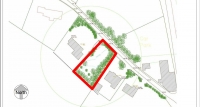
In the third instalment of Nessa Duggan’s column on designing and building a passive house for her young family, she describes the process of designing a house to suit the family’s lifestyle.
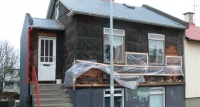
We all do, argues Dr Peter Rickaby, but the goal of mass retrofitting our energy inefficient building stock is hampered by the fact that when it comes to most retrofits, we simply don’t know what we’re trying to achieve.
Isover launches SpecHub, new online hub for technical construction info
Written by Lenny Antonelli
Isover Ireland has announced the launch of SpecHub, an innovative new specification and project tracking service. This new service allows registered users access to a host of technical information including CAD and BIM files, access to Isover’s technical team, as well as direct information on Isover Academy training courses and CPDs.
Kingspan launches new lower lambda Kooltherm range
Written by News Desk
Kingspan Insulation has announced that it has “revolutionised” its rigid insulation technology with the introduction of new low lambda products for floor, wall and soffit applications — delivering premium thermal performance with a minimal construction thickness, with a lambda value of just 0.018 W/mK.