Since establishing UCD’s Energy Research Group in 1975, the career of Professor J Owen Lewis has taken in the role of principal at the UCD College of Engineering, Mathematical and Physical Sciences, a Bord na Móna R&D directorship and expert roles advising EU research, national energy policy and building regulations. Appointed CEO of SEAI last year, Professor Lewis has been a champion of sustainable building since before the term existed. His selection combines a proto-green Alvar Aalto design, the reimagined Reichstag and an unusual academic building with two new cutting edge sustainable buildings.
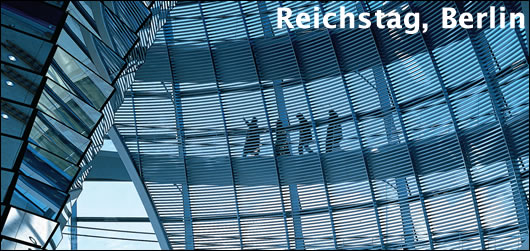
Built in 1884-1894 by Paul Wallot, in 1933 a fire partly destroyed the building. Rebuilt between 1961 and 1971, in 1992 Foster and Partners was one of fourteen non-German practices invited to compete to refurbish the Reichstag. The practice won the competition after a second stage in 1993 and the reconstruction began following Christo and Jeanne-Claude’s “Wrapped Reichstag” project of July 1995. The architects preserved various imprints of the building’s history including graffiti left by Soviet soldiers, allowing the Reichstag to become a living museum of recent German history within the parliament of a unified Germany in its new capital. It’s a landmark in many ways, including highlighting the sustainability of building rehabilitation – the core challenge for this generation of European architects.
The commitment to public accessibility is remarkable. Public and politicians enter together through the reopened formal entrance. The public realm continues on the roof in the terrace restaurant and the 23m high cupola where 230m long helical ramps lead to an observation platform, allowing the people to ascend symbolically above their elected representatives in the chamber. Great queues form to reach the roof terrace and its view of the city, and the even more amazing views from the cupola.
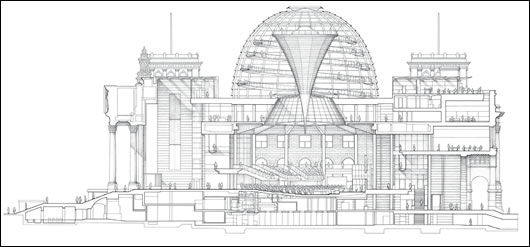
Originally finished in 1894, the refurbishment was designed by architects Foster and Partners
The historic building still retained some of the outstanding features planned well over one hundred years ago – natural ventilation, selective use of its enormous thermal mass, and good daylighting. Minimisation of environmental impact was an important priority during the refurbishment, and substantial expert support was provided to the design team within a European Commission programme co-ordinated by the UCD Energy Research Group.
Renovation of the envelope combined controllable natural ventilation and integrated air treatment. Daylighting is enhanced by the re-introduction of glass roofs, as well as new glass floors and walls deep inside the building. The cupola is crucial to its lighting and ventilation strategies. At its core a light sculptor reflects low level light into the chamber, with a moveable shield blocking excessive solar gain and glare. As night falls, this process is reversed and the cupola becomes a beacon.
The building’s energy strategy was devised by Kaiser Bautechnik with Foster and Partners, with renewable biofuel of refined vegetable oil used to co-generate electricity and heat to achieve a 94% reduction in carbon dioxide emissions. Surplus heat is stored as hot water in an aquifer 300 metres below ground, and can be pumped up to heat the building or to drive an absorption cooling plant to produce chilled water. This, too, can be stored below ground. The modest energy requirements allow the building to contribute to the heating and cooling of the neighbouring government quarter.
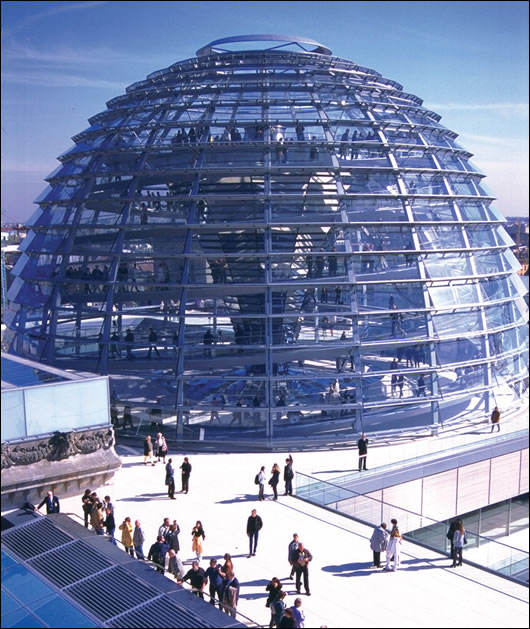
The building's public realm continues up to the roof, allowing people to symbolically ascend above their elected representatives
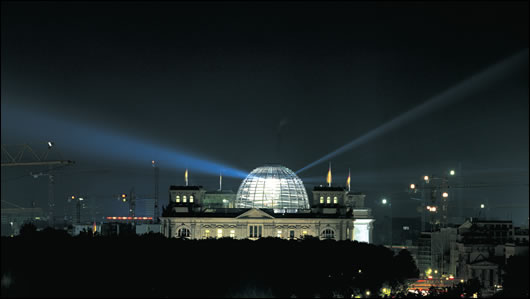
At night the cupola becomes a beacon of light for Berlin
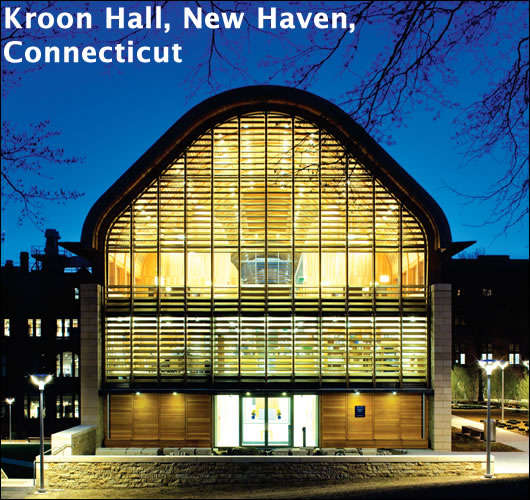
Housing the Yale School of Forestry and Environmental Studies, Kroon Hall is LEED Platinum certified by the US Green Building Council. The brief sought to set new standards for university buildings in the US; Kroon Hall was designed to use 81% less water and 58% less energy than a comparable building, and to generate 25% of its electricity on site from renewable sources.
Designed by Hopkins Architects in collaboration with Centerbrook Architects and Atelier Ten environmental designers, Kroon Hall incorporates a remarkably wide range of sustainable strategies and design features reflected in its maximum LEED rating, and illustrating the breadth of issues to be addressed. Completed in January 2009, the 6,390m2 project cost (land excluded) $33,500,000.
The significant local seasonal variation necessitated an adaptable building that could be closed during summer and winter, yet opened to allow for natural ventilation during the transitional seasons; the narrow floorplate and large windows facilitate natural cooling. The building is oriented along an east-west axis, allowing the southern façade to act as a passive solar collector. It takes advantage of the site’s slope by embedding most of the ground floor in the hillside. External PV and solar collectors are incorporated into the design and not simply fixed onto the façades, and the large roof is sloped to provide the PV panels with a nearly optimal angle for year-round production.
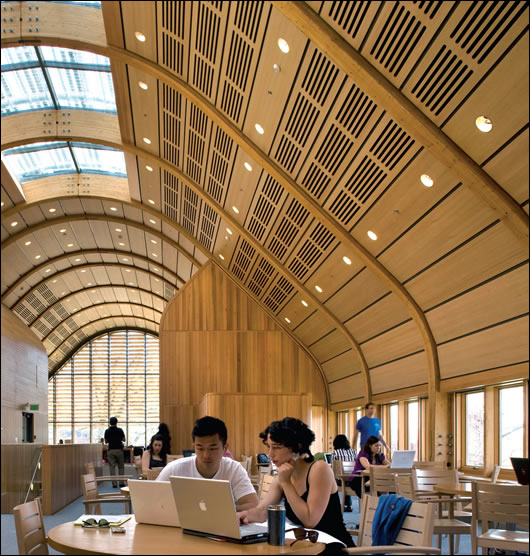
Kroon Hall is home to the Yale School of Forestry and Environmental studies
North and south façades feature deeply recessed windows and highly insulated stone veneer walls, which combine with significant thermal mass in exposed concrete soffits and stair cores to provide year-round climate control. The open central stair allows for stack-effect ventilation between levels. Indirect adiabatic cooling and heat exchangers recover 75% of energy from exhaust air, and four ground source heat pumps help regulate interior conditions. A 105kW integrated solar array on the roof provides 25% of the building’s energy. Lighting throughout is high-efficiency and is controlled by occupancy sensors, and most lamps are fluorescent or LED. All additional energy necessary for the building comes from offsite renewables via carbon offset credits. Building energy use can be monitored by occupants at all times via two touch-screen monitors in the lobby.
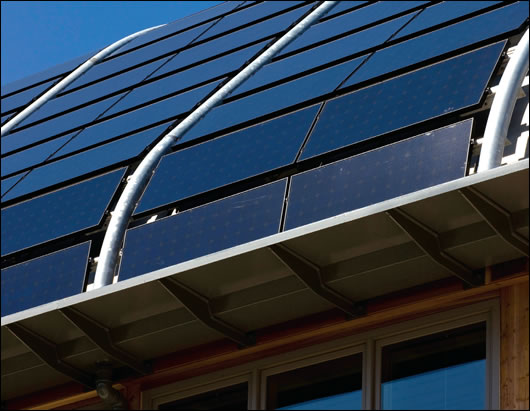
External PV and solar collectors are incorporated into the design rather than fixed on to facades
Other features which improve the LEED score include use of a brownfield site, designed to have pedestrian rather than automobile emphasis with access to public transportation, and providing showers and changing areas for bicycle and pedestrian commuters. An innovative application of rainwater treatment, storage, and reuse includes a landscape water feature that uses plants to cleanse stormwater.
The first 25mm of rainwater runoff is diverted to this water feature. Treated overflow is directed to a subsurface cistern, from which it is continually recycled through the water feature by a small pump. This water is available for toilet flushing and to irrigate portions of the landscape, which features indigenous vegetation. Potable water use is reduced 75% via waterless urinals, dual-flush toilets, and other features.
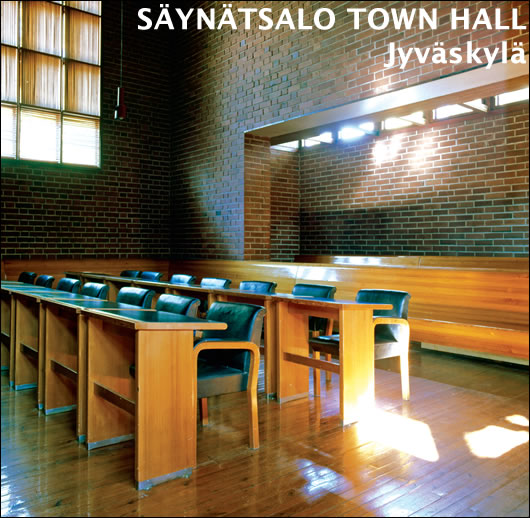
The result of a 1949 competition, designed by Alvar Aalto and built in 1950-51, a thorough renovation of the building was undertaken in 1996-98 to tackle moisture problems in the interior and to repair the roof, as well as upgrading building services. The design made an important contribution to the development of a critical regionalism, standing in stark contrast to the International Style and more recent self-indulgent fashions and fads. Lewis Mumford promoted the concept of regionalism as a “native and humane form of modernism,” which acknowledged local cultural, historic, climatic and geographic influences while using modernist forms. To J M Richards, Säynätsalo “is intimate and idiosyncratic, with an unusual layout directly responsive to the genius loci”.
The original brief called for a town center – a mixed-use complex containing commercial, residential, and local government functions. Aalto evidently disliked the commercial functions of the building, putting them on the ground floor, surrounding a mound of earth and partially submerged. The council chamber sits above the rest of the functions, the form of the building emphasising the chamber. The partially enclosed courtyard is elevated one storey above street level (using material excavated for the buildings' foundation), partly in response to the building’s sloping site, and partly to accord increased status to the civic realm over the private sector. The two-level library massing serves to tie together the two.
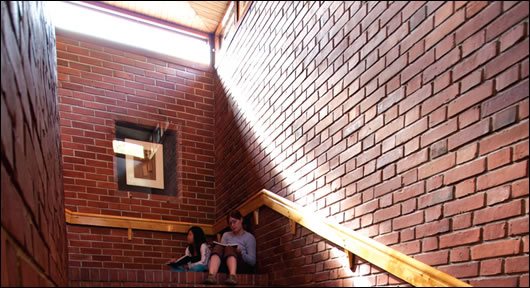
The palette chosen by architect Alvar Aalto emphasised natural, unadorned materials such as brick
The palette comprises natural, unadorned materials including dark red brick, wood and copper, with glass and pieces of stone or dark ceramic. The solid brick volumes are foils to glazed areas. Säynätsalo Town Hall’s success has been said to reside in its understated monumentality, scaled to the common person. David A Gross: “Infused with regionalist cues, the entire composition is forthrightly Finnish, while exhibiting a modernist eloquence connecting the work to the wider world.”
The consideration of lighting in the building is remarkable. The offices around the perimeter of the building are surrounded by tall trees and get little light. In the winter, the sun barely rises, and in the summer, the foliage provides shading. Aalto cleverly used the open courtyard to provide light, making the flooring in the corridor white so that it would bounce off the floor and into the offices. Inside the council chamber, the lighting is dramatic, dim and directed. There are no views out, and the louvres on the windows direct light to specific places. One window washes light onto a painting and the wall, highlighting the wonderful texture of the bricks. A large “checkerboard” window directs some light onto the council chair’s desk, and other light back onto the council and the gallery seating.
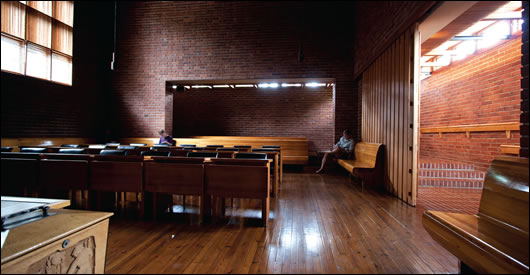
Inside the council chamber the lighting is dramatic, dim and directed to specific points
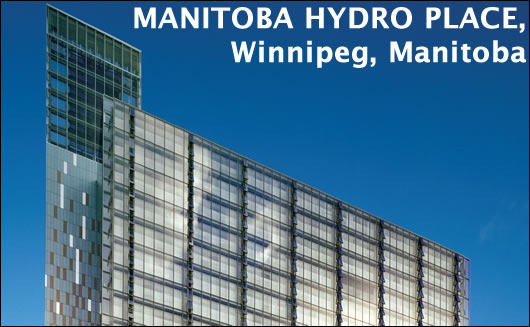
Manitoba Hydro is the fourth largest energy utility in Canada and is owned by the provincial government. Nearly all of its electricity comes from hydropower. Its new headquarters, completed in 2009, is located in downtown Winnipeg, where temperatures fluctuate from -35 to +34C. The 64,500m2 building was designed by Kuwabara Payne McKenna Blumberg Architects and energy/climate engineers Transolar to use 88 kWh/m2/a, compared to 400 kWh/m2/a for a typical large North American office tower located in a more temperate climate. The site was selected because nearly all city bus routes pass, including routes to suburban Winnipeg where 80% of Manitoba Hydro employees live. The integrated design process is of particular interest, and included extensive computer modeling using local wind, solar and temperature data to evaluate design options.
Two 18-storey twin office towers rest on a stepped, three-storey podium. The towers converge at the north and splay open to the south for maximum exposure to the sun and consistently robust southerly Winnipeg winds. The podium includes a sheltered pedestrian route through the full city block. Narrow floor plates and tall floor-to-ceiling glazing allow sunlight to penetrate into the core. A double façade curtain-wall system comprised of a double-glazed outer wall and a single-glazed inner wall of low-iron glass, forms a one meter buffer zone. Automated louvres control glare and heat gain.
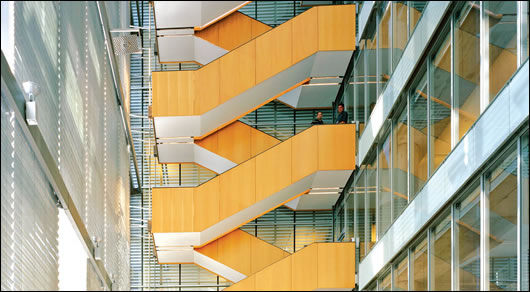
Within the splay of the two towers, a series of three, six-storey atria form the lungs of the building, drawing in outside air and pre-conditioning it
A 115m tall solar chimney marks the north elevation and main entrance, and is a key element in the stack effect passive ventilation system. The chimney draws used air out of the building during the shoulder seasons and summer months. In winter, exhaust air is drawn to the bottom of the solar chimney by fans, and heat recovered from this exhaust air is used to warm the parking area and to preheat the incoming cold air in the south atria. Within the splay of the two towers, a series of three, six-storey south atria form the lungs of the building, drawing in outside air and pre-conditioning it. Depending on the season, a 24m Mylar ribbon water feature in each of the atria can humidify or dehumidify the incoming air. During colder temperatures, recovered heat from exhaust air and passive solar energy are used to preheat the 100% fresh air. The conditioned air is drawn through raised floors into the office spaces through fan units. Air is then drawn north and exhausted by the solar chimney. In the shoulder seasons, the building relies solely on outdoor air through the use of automatic and manually operated windows.
Manitoba Hydro Place uses a large closed loop geothermal system comprising 280 boreholes, each 150mm in diameter penetrating 125m underground, and circulating glycol which is cooled in the summer and heated in the winter. Water is circulated through heat exchangers and distributed through the thermal mass of the concrete structure which in turn heats or cools the space consistently. Manually operated windows on the interior curtain wall, combined with the automated exterior wall vents controlled by the BMS, allow individual environment control. In both the north and south atria, interconnecting stairs promote physical exercise, reduce reliance on elevators and provide opportunities for interaction between divisions.
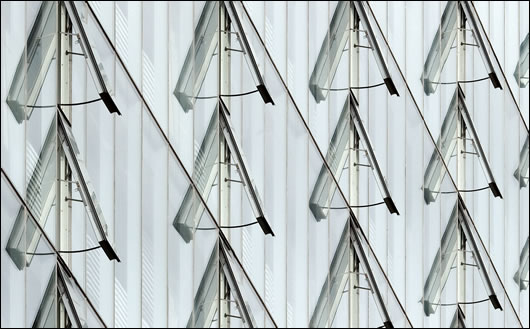
The building has a double-facade curtain-wall system comprised of a double-glazed outer wall and a single-glazed inner wall of low-iron glass. Automated louvres control glare and heat gain
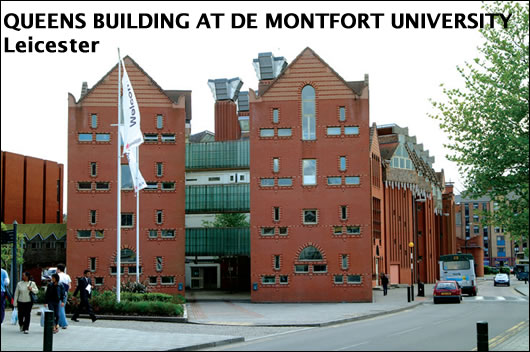
Designed by Short Ford & Associates architects and engineers Max Fordham Associates to house the School of Engineering and Manufacture, and important as an early demonstration of the potential of natural ventilation in complex buildings. Tall ventilation stacks circulate cool air throughout the building, and glazed ventilators help to provide as much natural lighting as possible. The innovative structure has wide insulation-filled cavity walls and exposed concrete soffits for additional thermal mass. Apparently, the university wanted a traditional brick building so that construction would generate job opportunities in an area of high unemployment.
The Queens Building was opened in 1993. I recall lecturing in the building just days before Elizabeth ll performed the official ceremony, at a time when the Irish were under some scrutiny in Britain. The 10,000m2 building cost about £10 million to construct and has a treated floor area of 8400m2, using 143 kWh/m2 for heating, and 52 kWh/m2 electricity according to Bill Bordass and Adrian Leaman who undertook extensive post-occupancy studies (POE) of the building.
The building has three distinct parts. The first comprises the two wings of electrical laboratories that create an entrance courtyard. The floorplate increases on the upper floors to reduce direct sun penetration. Small windows with deep reveals decrease the amount of direct solar gain while light shelves bounce the daylight off the ceiling deeper into the space. The courtyard walls are painted white to reflect light towards the lower floors.
The central building has eight distinctive chimneys piercing through the double-height concourse which creates a separation between the labs and the auditoria, and provides a comfortable meeting area in winter. Rooflighting brings natural light deep into the space and exhausts the warm air through stack effect; ramps throughout this space contain glass brick to improve daylighting. In the general lab toplighting is also used whereas the offices, auditoria, studios, and computer labs are side-lit. In the auditoria fresh air enters through louvres in the north façade by means of plenums below the raked wooden floor and wall inlets which are controlled by the BMS. Two 133m chimneys ventilate the space.
The third part houses the toplit mechanical labs. The gabled street façade features large windows allowing controlled natural daylighting, and exterior brick piers whose perforated coursing doubles as an air intake louvre.
Other green features claimed for this 1993 building include a designated recycling area, low-energy lighting, intelligent lighting controls, gas condensing boiler, double-glazing throughout, draught lobby entrance, design for passive solar gain, water conservation, cycle parking, PVC alternatives, recycled materials, and grounds managed to protect habitat. Just four years ago the POE was revisited by Roderic Bunn who recorded significant changes to some elements of the building’s energy operation and continuing localized comfort issues: but the building provides a key illustration of the powerful lessons to be learned from rigorous study of performance in use.