Solearth partner & Éasca board member Mike Haslam profiles five inspiring English and US projects that share a similarly considered green design approach
If there was a title for Ireland’s greenest architects, Dublin-based Solearth Ecological Architecture would be strong contenders every year – the practice has been creating award-winning and thoroughly sustainable projects of every shape, size and type for several years. Solearth partner & Éasca board member Mike Haslam profiles five inspiring English and US projects that share a similarly considered green design approach.
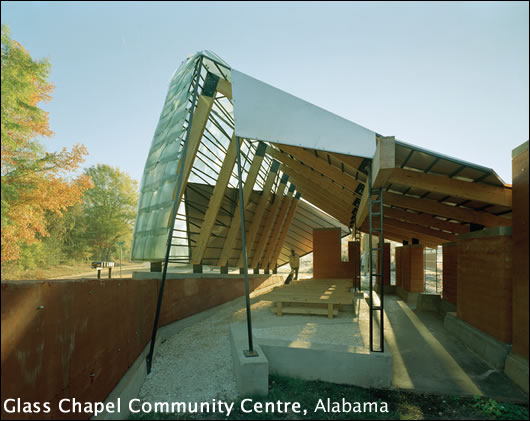
The pioneering work of Rural Studio in Alabama’s Hale County tackles issues of poverty, ecology and community. Established by the late Samuel Mockbee, the studio involves the creative energies of his students from Auburn University. Working in local materials and salvaged scrap and under the guidance of Mockbee and his team, the students design and build inexpensive buildings of contemporary modernism that are grounded in a southern state’s culture. Mockbee noted that these projects are a social welfare venture and an invaluable educational experiment.
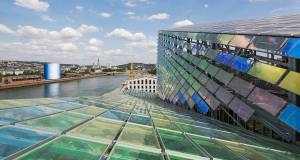
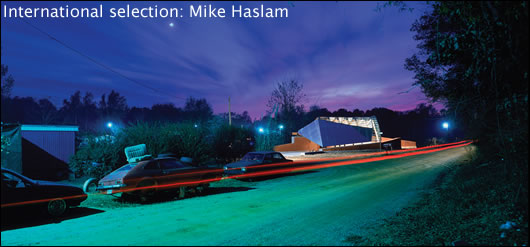
Glass Chapel community centre started life as a student thesis project in 1999; the community had little in the way of sheltered communal space and a plot of land was donated to allow for a building whose brief was for a community centre that could double as a chapel. Constructed the following year, the resultant building is one of the most eye catching of all Rural Studio’s projects – which Mockbee called “a windshield chapel with mud walls that picks upon the community’s vernacular forms and shapes.” Its folded metal and glass roof provides a cutting edge contemporary look akin to a fish scale glass membrane. It is of course the result of an economy of means and pragmatic creativity that is the hallmark of Rural Studio.
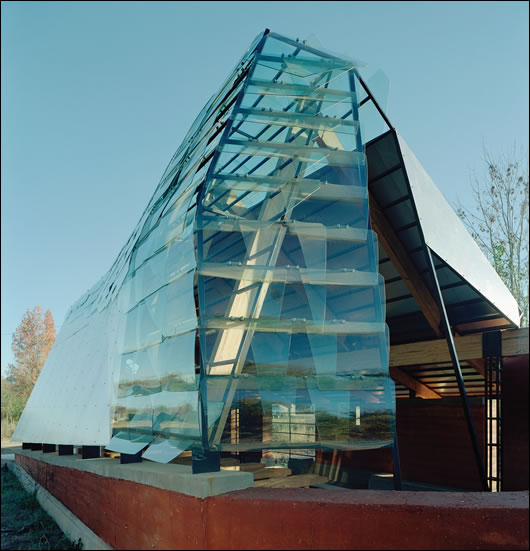
One of the most notable features of the building is the car windshield cladding sourced from the local scrap yard
The open air pavilion rests on a broad base of rammed earth – 30% clay, 70% sand – derived from the site. The timber frame is constructed from local cypress trees; the structural steel where it is required was donated by a journalist – establishing a worthwhile precedent for Construct Ireland! However the most notable feature is the fish scale roof which was up-cycled from the local scrap yard: $120 for 80 chevy caprice windshields. All in all the community centre was built for $20,000.
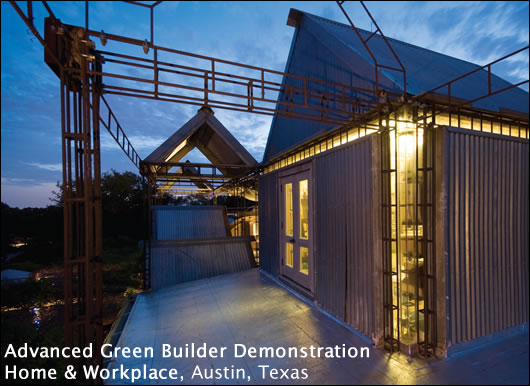
The centre for Maximum Potential Building Systems – or more simply Max Pot – is co-directed by Pliny Fisk and his partner Gail Vittori. It encompasses an architect's studio, workshop, research laboratory, teaching centre and experimental concrete plant. On the same plot of land is the Advanced Green Builder Demonstration home and workplace, a government and industry-sponsored project. With its heavy base, light steel roofs and water cisterns, it is designed to be an example for modern regionally appropriate architecture. As such it emphasizes opportunities for recycled and by-product materials, water collection, natural cooling and heating. However, what distinguishes the project – which Solearth partner Brian O’Brien helped design and construct in 1995 – and indeed the work of Max Pot as a whole, is the depth and solidity of their holistic approach to building.
The approach sees built form as a product of an informed understanding of the environment in which it is set. This information takes the form of a regional mapping which defines the ecological and economical context. On the one hand mapping is used as a tool to identify plant species, soil types, rainfall, wind strength and insolation. As such it defines the biome or bioregion – an area with a distinct set of climatic, vegetation and soil characteristics. On the other hand mapping is also used as a statistical base to identify human resources such as transport networks, manufacturing processes and job skills.
A database is derived which allows the architect to cross disciplinary borders and operate in the realm of ecological land planner or industrial ecologist. From the biome mapping one can assess the potential for wind power, photovoltaic cells and rainwater collection; and in terms of materials, the scope for the use of abundant local resources – soils for example – or easily renewable resources such as straw or timber.
Equally one can look at the regional availability of manufactured goods, industrial by-products and local skills. The resource mapping becomes the basis of a life cycle assessment from source to sink of material usage. Fundamental to this assessment is the development of an economy of means in the construction and operation of human habitats, with the intent of relying on a region's indigenous materials and human resources. In this way minimal transport costs are incurred with consequentially reduced environmental damage and its subsequent costs. From this one gains the understanding of a region as an integrated dynamic system, potentially self-sustaining, through a system of material flows and information loop-backs.
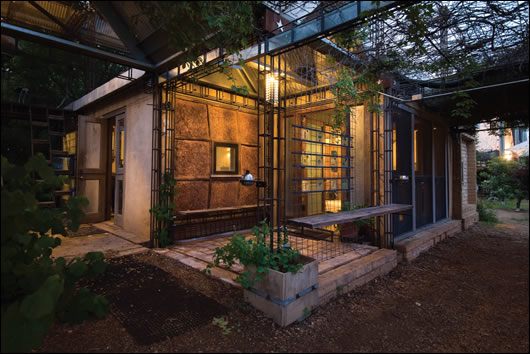
The building is based on a modular system consisting of an endo-skeleton of steel reinforcing rods – 98% locally recycled and recyclable – welded together into a box frame to form simple column and beam elements. These are then bolted together, and through its clip-together structure the building can be enlarged or reduced easily. Infill panels are made from recycled or indigenous materials such as adobe, rammed earth and straw
A new product potential is in this way liberated: what otherwise is seen as waste or a pollutant can be seen as a possible cheap and abundant material source that, until this point, had found no use. In other words, value is put on the disposer-recycling sector of the economy and not just the producer and consumer.
There is also an outward looking component to the mapping process. Unesco already uses biomes as a basis for information sharing. Pliny Fisk has used this technique to learn through the experience of resource use in other parts of the world where near identical ecologies exist. The Southern Texas biome is comparable with parts of Iran, Argentina and North Africa. This referencing allows the sharing of appropriate material uses or environmentally responsive forms between climatic partners – thus enriching the vocabulary of each. The mapping and subsequent life cycle analysis database informs all design decisions and material choices. As Pliny Fisk is apt to quote: "form follows flow" – referring to the resource and material flux within the regional system.
The demonstration home is intended to address social concerns of flexibility and affordability. It is based on a modular system consisting of an endo-skeleton of steel reinforcing rods – 98 per cent locally recycled and recyclable – welded together into a box frame to form simple column and beam elements. These are bolted into position and are light enough to be manually manoeuvred. They can be subsequently encased in a precast permanent shuttering and concrete which uses a substantial amount of recycled content. Portland cement is avoided because of its contribution to global warming through excessive carbon dioxide release.
These column and beam elements generate a set of basic forms such as triangulated roof modules, porches, arbours and guttering supports. The ease of construction – which also entails minimal site disturbance allowing nature to quickly recolonise – and its inherent cheapness mean that a family can itself build a starter home without the burden of a mortgage. As the family grows or salaries permit, the building, through its inherent clip-together structure, can be enlarged or reduced to suit respective needs.
Infill panels are made from recycled or indigenous materials identified for their suitability through the mapping process. The demonstration home uses a variety of techniques, including adobe and rammed earth walls, straw bales with hand stuccoed finish for fire and pest resistance, recycled glass blocks and caliche blocks. Caliche, a calcium carbonate deposit, covers some 12 per cent of the earth's crust and is widely available in Texas. It can be mixed with sand, fly ash and other industrial by-products to form a solid and durable block for a solar-mass wall or for flooring slabs. In a biome short of virgin timber, window, door frames and panels are made from a combination of sawn timber chippings and locally recycled plastics, to give a new hybrid product that is both thermally stable and weather resistant.
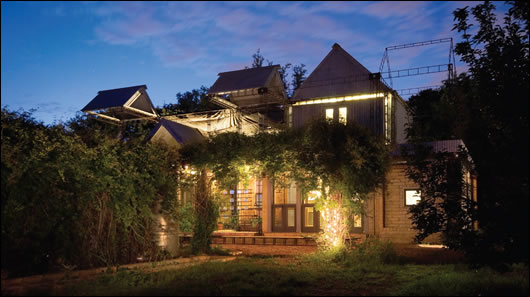
Framing the entrance to the building are two steel cisterns, designed to hold 13,000 gallons of rainwater collected from the roof. This visually embodies both the project's sustainable ethos and the average Texan's demand for water in a dry climate. The on-site rainwater catchment is intended to provide for all of the home's domestic water needs, with the necessary storage capacity estimated from precipitation mapping, including data on the likelihood and duration of droughts. The landscape surrounding the building similarly demonstrates the importance of water in a dry climate. At the foot of the water cisterns is an artificial wetland of reeds and gravel beds. These filter the grey waste water from the house and a solar powered water pump provides a low pressure dosing system across the garden.
The galvanised steel roofing and upper stories sit lightly above the building's mass on the skeletal overstructure providing ventilated shade below. The galvanised steel is locally manufactured with a roof membrane made of recycled tyres. All the south-facing roofs are decked with photovoltaic cells to provide electrical power.
A breezeway separates the two halves of the building – on the one side a workshop/studio, on the other the living area. The breezeway is a climatically responsive form of shaded, outdoor living space borrowed from traditional Texas housing. In a previous project for a farm and market in Laredo on the Mexican border, biome knowledge sharing allowed Fisk to use the climatically relevant form of a wind funnel roof, traditionally used in Iran for cooling. A variation on this is used in the demonstration home's clerestory ventilation.
The bridging of issues in architecture and ecology with social concerns entails an approach, which seeks to restore the cooperative imperative between natural and human systems to ensure their mutual survival. It is a regionalism born out of a rigorous understanding of context. In this respect it is akin to the tradition of a local building knowledge – but using the benefits of the computer age.
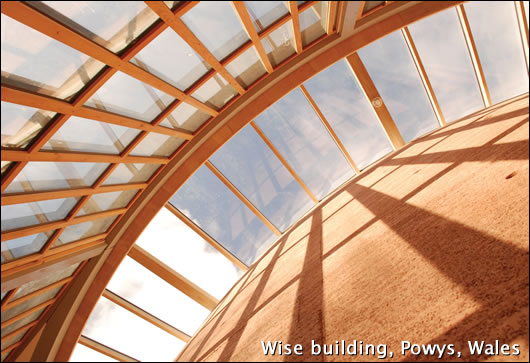
Situated in the scenic hills of southern Snowdonia, the Wales Institute for Sustainable Education (Wise) at the Centre for Alternative Technology (Cat) in Powys, mid-Wales has been constructed as a showcase of best sustainable building practice.
Cat is one of Europe’s foremost eco-centres with over 34 years of research and experience in sustainable living. It receives over 70,000 visitors a year and runs environmental courses ranging from weekend solar PV installation to academic courses from its Graduate School of the Environment.
Numerous buildings have been constructed on the 40 acre disused Llwyngwern slate quarry since Cat was founded in the 1970s, but none have been as ambitious as the Wise project.
Designed by Pat Borer and David Lea working with Buro Happold, Fulcrum Consulting and Bowen Consultants, Wise was developed to cater for the graduate school’s growing student body and course programme, and successfully combines environmentally conscious design and cutting-edge sustainable building techniques. The design utilises energy efficient glazing to enhance natural day lighting and passive heat gain, reducing energy requirements to a minimum – a demand met by on-site renewable energy sources including biomass and solar power. The attention to energy reduction goes beyond heating and lighting requirements – Wise has been sensitively constructed out of low embodied energy materials. Waste and water systems are designed using natural zero energy treatment.
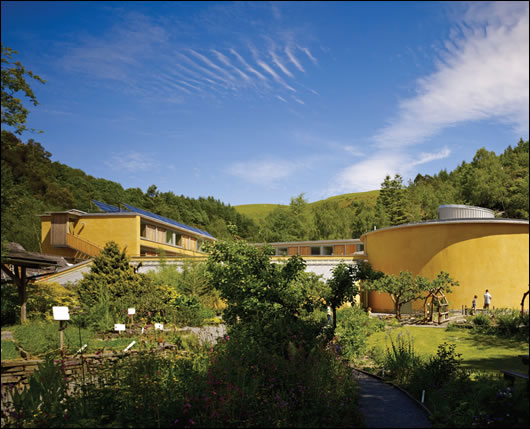
A roof garden provides a place for staff and students to meet and relax; taking advantage of the scenic surroundings
The circular lecture theatre’s 7.2 metre walls are the highest rammed earth walls in the UK. Rammed earth is a physical rather than chemical bond, mechanical compaction forces clay molecules to bond with the aggregate. The material chosen for Wise – sourced from Llynclys Quarry 45 miles away – was a waste product that had already been processed, and had a suitable grading of 6mm particles downwards.
The building’s main timber frame is made from FSC-certified European whitewood glulam timbers and jointed with steel flitch plates. The timber frame is completely enclosed by 500mm thick hemp and lime walls; this provides a high degree of insulation and airtightness whilst remaining breathable.
Sand lime bricks – calcium silicate bricks – were used to construct the plinth walls that support the building’s frame. They are autoclaved – a process of curing in pressurised steam – instead of being fired, thereby giving them a lower embodied energy than standard clay bricks. The brickwork forms a cavity wall filled with perlite to provide insulation, the top few inches of which were mixed with limecrete to provide a cap to the wall. Traditional fired clay pipes were chosen instead of PVC duct and drain piping.
To increase the thermal mass of the building earth blocks made from un-stabilised subsoil compressed in a mould were used for internal partition walls on the ground floor. The blocks were laid using a thin layer of clay slurry as mortar.
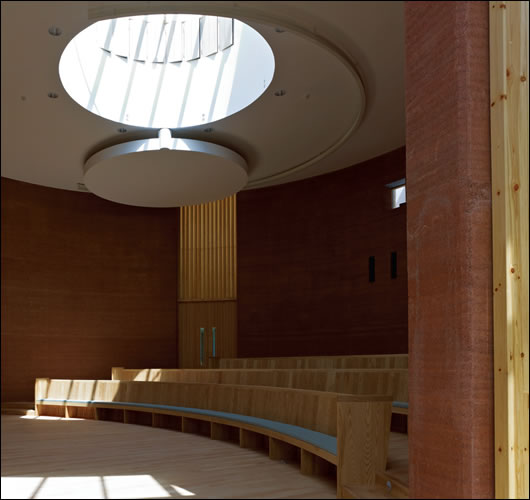
The circular 200 seat lecture theatre has the highest rammed earth walls in the UK at 7.2 metres tall
All of the aggregate fill for the foundations came from slate on site at Cat. Parts of the site had bedrock (a low grade slate) that needed to be removed, and this provided sufficient loose aggregate to fill the areas required to create a level site. The foundations are made from limecrete. However it was necessary for concrete to be used for the raft and raking foundations, 50% of the Portland cement was substituted for GGBS in the concrete to reduce the embodied energy of the concrete.
The ground floor slabs have been insulated with perlite, a volcanic rock which puffs up when heated to high temperatures, as have some walls and ceilings. General cellulose has been utilised for roof insulation. To prevent cold bridging in the foundations and roofs natural cork has been placed in key areas as an insulation layer.
Wise is fully integrated into other Cat site systems including the existing district heating system – into which excess hot water from the building’s solar thermal system can be exported – and will connect to a new woodchip-fired combined heat and power plant when it comes on line.
Semi transparent photovoltaic panels made from crystalline wafers provide both energy and shading for the building. The grid-connected panels are fitted into a traditional glazing system fixed to the glulam timber rafters and have a peak output of 6.5kW.
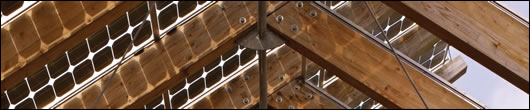
Semi transparent photovoltaic panels, fitted into a traditional glazing systems fixed to the timber rafters, help provide electricity and hot water
A variety of water efficiency techniques have been employed at Wise: to minimise all dead-leg volumes in the pipe work, pipe sizes have been kept as small as possible and pipe runs kept short. Hot water pipes have been fitted above cold water pipes to prevent warming of cold, and all pipes are insulated.
Single lever ceramic disc mixer taps have been used, with regulated aerators and "eco-brake" flow control with central cold only mixing. This discourages excess flow but allows higher flows if needed. Flow regulated aerators also prevent splashing.
Showers are fitted with thermostatic mixer valves, with separate flow and temperature control and six litre per minute shower flow regulator on outlets, saving water and energy without sacrificing comfort.
WCs have an actual effective flush of less than four litres per use and leak free flush mechanism. This guarantees long-term water savings without compromising function or drain carry, is low maintenance, and has an easy to fix siphon flush mechanism. Waterless airflush urinals have been installed – using a fan to create negative pressure in the waste-pipe so there is a constant draught down the urinal trap.
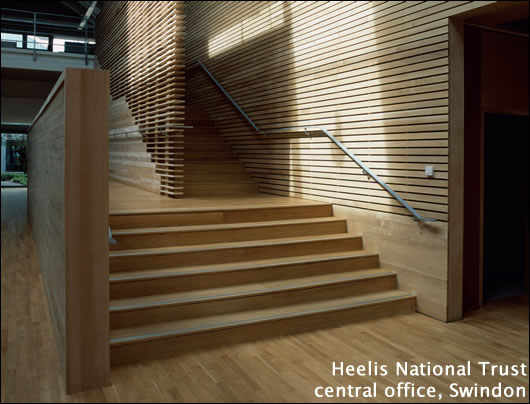
FCB Studios – the practice established by Peter Clegg and the late Richard Feilden – has been one of the pioneers of sustainable design in the UK long since before sustainable became a buzz word. Some of their early buildings are certainly pioneers such as the BRE headquarters at Garston –which demonstrates natural ventilation techniques – and the oak framed Bedale school theatre. Latterly they are now well known for the Stirling prize winning Accordia housing in Cambridge.
Heelis – designed by FCB Studios and Max Fordham and constructed in 2005 – is interesting for its investigation of a low energy office building type and for the successful marriage of sustainability with a contextual derived form.
The site was once part of Brunel’s Great Western Railway works adjacent to 19th century engineering sheds which acted as this contextual precedent. Interestingly this precedent was far from wilful as the Victorian sheds derived their form from the need for daylight and natural ventilation of a load-dominated working environment. Thus the lofty two storey structures with their regular rhythm of pitched roofs were well-suited for a modern reinterpretation in an office building.
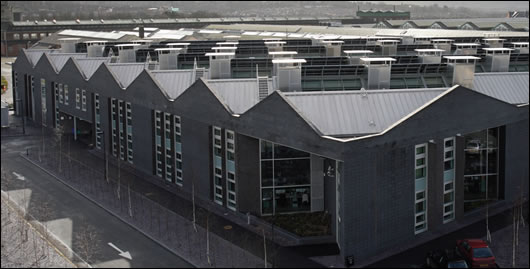
The roofscape is designed to aid natural ventilation, and also hosts a vast solar PV array which supplies the majority of the building’s electrical demand; brise soleil and roof overhang provide shading for pathways and the building
Heelis takes this form but turns the roof ridge to provide a south facing slope for solar collection and a north-facing slope for day lighting. The deep plan of the building suited the u operational layout required by the National Trust and entailed that – unlike most office buildings – it is the roof that provides the major envelope connection with the external environment. As the building is only required to be two-storey, workstations are always close to daylight and natural ventilation even in the heart of the plan. In addition to this internal courtyards help provide a visual connection with the outdoors. Roof lights are shaded by the PV panels to prevent unwanted solar gain and ventilation cowls operate independently of wind direction with some automation to facilitate summer nighttime cooling. It is not a completely naturally ventilated building: low-level mechanical ventilation with heat recovery helps keep the building’s heat requirement at 13 kWh/m2/yr.
Around 82% of the electrical demand of the building is serviced by the 1400m2 rooftop-mounted PV array – a truly productive surface the like of which was pioneered at FCB Studios’ previous Oxstalls campus building in Gloucestershire.
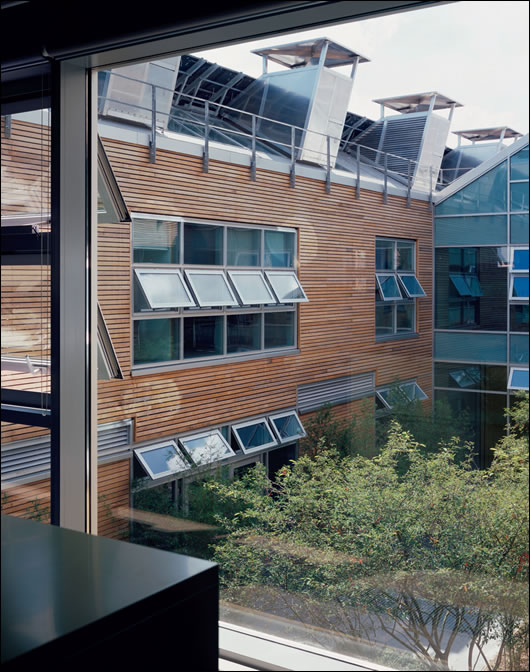
Internal courtyards help provide a visual onnection with the outdoors
Studies showed that in terms of lifecycle analysis, rainwater harvesting was less cost-effective for this building than the introduction of water saving measures such as waterless urinals and these measures have reduced water consumption compared to a typical office building by some 60%.
As befits a practice with such experience in ecological design, material choice was determined by matrix evaluation based around the green guide spec. This included sourcing the wool for the carpets from the National Trust’s sheep and timber from their estates. The positioning of the central office was selected with the proximity of the rail connection in mind – an especially important consideration with a Trust that covers the whole of the UK.
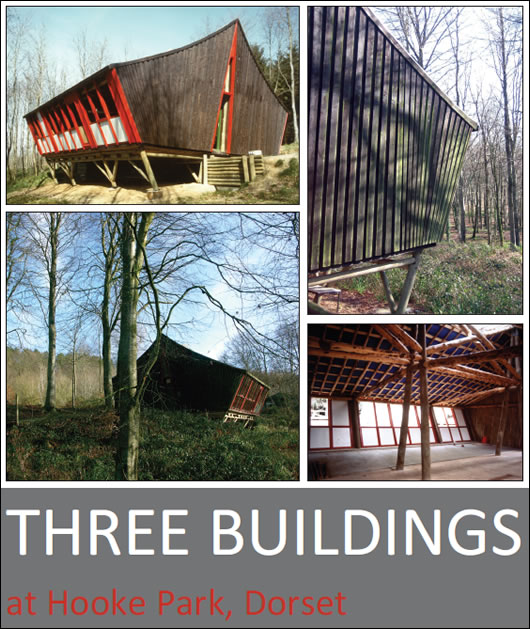
Prior to coming under the ownership of the Architectural Association, Hooke Park was developed in the 1980s by the Parnham Trust as a college for teaching and researching new ways of using wood in furniture and construction. A small campus was built in the forest, with the aim of utilising low-value timber thinnings from the surrounding forest as construction material. The result was three groundbreaking prototype buildings, which demonstrate the rich potential of round-wood construction.
John Makepeace first conceived of the idea of a forest campus school for furniture design in 1979 and central to Hooke Park’s programme of research and development was the idea of living and learning in buildings that were effectively grown from the surrounding woods. One aim was to provide new models for rural housing in the 21st century, particularly in sensitive landscapes like those of west Dorset and the final project – not built – of the Parnham Trust was Park House – a modular student hostel from spliced round wood designed by FCB Studios with Buro Happold as engineers. The three buildings constructed by the trust form a powerful architectural legacy.
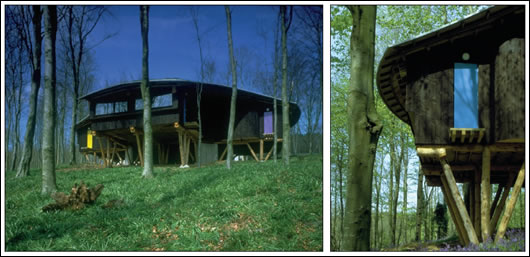
Westminster lodge was finished in 1999 – it’s comprised of a timber lattice of spruce thinnings that carries a planted turf roof
The Refectory, by ABK and Frei Otto with Buro Happold, was built in 1985. It was designed as a prototype house and uses an experimental structure that consists of round wood A-frames from which a tent-like tensile timber roof is suspended. Today, the building contains the kitchen and dining space for staff and students.
The Workshop, again by ABK and Frei Otto with Buro Happold, is formed with a compression grid-shell structure. Complete in 1989, the result is a long-span enclosure built using forest thinnings formed by a glued connection into an extruded timber spaghetti. Two of the three bays of the roof accommodate a large fully equipped timber workshop, whilst the third contains an office-studio with computing u facilities and a small library.
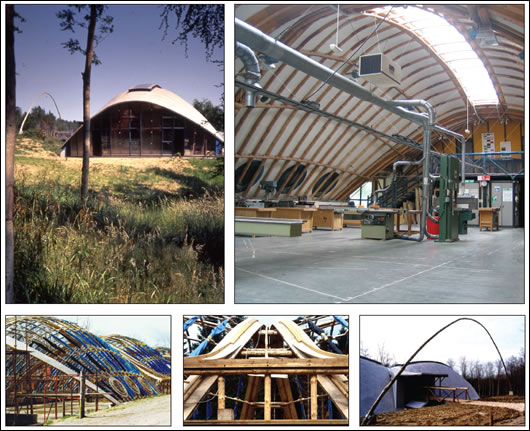
The Workshop is formed with a compression grid-shell structure. The result is a long-span enclosure built using forest thinnings formed by a glued connection into an extruded timber spaghetti
The dormitory, Westminster Lodge, was completed in 1999. Designed by Edward Cullinan with Buro Happold, it also uses green wood from Hooke Park’s forest, providing eight bedrooms around a central communal space. A timber lattice of spruce thinnings carries a planted turf roof.
All three buildings utilise waste timber from the furniture college and construction as the fuel for heating and close the water cycle with both on site collection of water and treatment of wastewater. The result is a powerful set of buildings that work well with the surrounding ecology.