
Solar Decathlon kicks off a school built from plastic bottles the best green building blogs
Written by Lenny AntonelliHere's our semi-regular round up of links that might be of interest. Have a good weekend everyone.
The 2011 Solar Decathlon — which challenges US university teams to build solar-powered homes over a week — is under way. Follow their blog and Twitter updates. Here's a video tour of just one of the projects.
[video:http://www.youtube.com/watch?v=c7GPeEY9dYM 500x400]
Building a school from plastic bottles for $10,000 good.is
Is green building really for everyone? Green Building Advisor
Do hybrid solar thermal-PV panels increase efficiency? Jetson Green
The cost of solar PV technology continues to drop Jetson Green
Seven green building blogs you should be reading Centre for Alternative Technology
Timber frame self build: an empowering journey in sustainable building skills Centre for Alternative Technology
Thoughts on a sustainable human ecosystem The Oil Drum
Peak oil — now or later? Energy Bulletin
Is this "zero net energy home" a model for mainstream housing in the future? Treehugger
Global eco building inudstry unites for Green Building Week
Written by News Desk
The property and construction industries from 89 nations representing more than 30,000 organisations have united for World Green Building Week, from 19-23 September. The Irish Green Building Council is hosting a series of events as part of the week.
World Green Building Week aims to highlight the important role that green buildings play in improving the global carbon footprint, while also saving money, creating jobs and reducing poverty.
Heating expert Des Flynn of RVR outlines the importance of weather compensation in boiler systems.
Weather compensation is a control strategy which is used to adjust the heat output of a boiler in proportion to the outdoor air temperature. This is generally implemented by adjusting the setpoint of the central heating flow temperature so that the flow temperature increases as the outdoor air temperature decreases. This is shown in the following graph.
Heating systems are designed for worst case weather conditions. In Ireland the outside design temperature will be between -3ºC and -10ºC depending on the location. The central heating flow temperature required at the design temperature is usually about 80ºC.
However the average outside air temperature during the heating season is much higher than this. In most locations it is about 8ºC. Under these average conditions the higher central heating flow temperature is not required.
The weather compensation system monitors the outside air temperature and adjusts the central heating flow temperature accordingly.
Flow water temperatures are kept as low as possible resulting in higher system efficiencies. There is a particular benefit when weather compensation is used with condensing gas boilers as the efficiency of the boiler is greatly increased.
The efficiency of a condensing boiler is dependant on the return water temperature. The lower the return water temperature the more efficient the boiler.
When the combustion products are below their dew point of about 55ºC, the boiler is in condensing mode and its’ efficiency increases almost exponentially. Weather compensation is of advantage in systems where high temperature heat emitters such as radiators are used as it allows the system temperature to decrease sufficiently for the boiler to condense.
A boiler which heats radiators and is not fitted with weather compensation will rarely be in condensing mode and will have a much lower efficiency than a boiler which does.
Comfort is also enhanced as the output of the Central Heating system automatically adapts itself to the weather conditions. This results in a reduction in ON/OFF cycles of the boiler.
An important aspect of weather compensation is ensuring that any hot water demand is satisfied at a higher temperature if the boiler is running in weather compensated mode. As domestic hot water is usually heated to 60ºC, high temperature boiler water is needed to do this. To allow this, boilers can use a feature called “Hot water priority”. This is achieved by having separate flow and return pipes for the central heating and the domestic water heating tank. When there is a demand for hot water heating from a water heater thermostat or sensor the boiler diverts the flow to the water heating tank, gives priority to hot water heating and raises its flow temperature to 80ºC until the hot water demand is satisfied.
Straw bale housing demolishing unfinished estates tribute to green pioneer Ray Anderson
Written by Lenny AntonelliHere's a round up of some green building and energy links that might be of interest. Busy at work here on the new issue of the mag — a passive house special edition, which goes to print early next week.
Straw houses baling out council building plans in the UK Guardian (with images here)
Demolishing Ireland's unfinished estates Ireland After Nama
Controversy brewing: the German Passivhaus Institut disowns its US satellite Green Building Advisor (more here)
Profile of the "ultra green" Zero Cottage in California Jetson Green
Insulating old brick buildings Green Building Advisor
A green roof evolves at the Museum of London Treehugger
Why the US Energy Information Administration's analysis of peak oil is flawed Energy Bulletin
Leading green architect Michelle Kaufmann remembers sustainability pioneer and entrepreneur Ray Anderson, who died on 8 August MichelleKaufmann.com
Solar Decathlon 2011 just around the corner
Written by Lenny AntonelliThe 2011 US Solar Decathlon — which challenges university teams of architects, engineers and students to design houses powered by the sun — kicks off on September 22 this year. Below is a video walkthrough of the design from one of the competing institutions, Appalachian State University. You can check out video walkthroughs for all the projects here, read about them all here, and get regular updates on Facebook and Twitter too. Construct Ireland previously took a detailed look at some of the buildings that competed in the 2009 US Solar Decathlon.
The first ever European Solar Decathlon was held in Madrid last year, with an American college emerging as the winner. We also published an extensive profile of one of the entrants to that competition, the Nottingham House, in the magazine.
[video:http://www.youtube.com/watch?v=9DN_g9hIcSA 500x350]
Wufi and thermal bridging workshops coming to Dublin
Written by News Desk
Joseph Little and Calina Ferraro of Building Life Consultancy, and Manfred Kehrer of the Fraunhofer Institute of Building Physics will deliver a two day workshop on Wufi Pro hygrothermal simulation software in Dublin on 15 and 16 September.
This workshop will teach attendees to use Fraunhofer’s Wufi Pro software for simulating heat and moisture transfer through building fabric for the purpose of assessing risk and preventing interstitial condensation. The focus of the workshop will be on the practical application of the software.
Oil price shock coming? mapping Ireland's empty houses passive house boom
Written by Lenny AntonelliHere's our usual round up of interesting links — have a good weekend everyone. The new issue of the mag goes to print next week.
Buried Treasure — a look at former Man United captain Gary Neville's underground house Michelle Kaufmann
Brace yourselves for the next oil price shock Energy Bulletin
Would you like to cover your house in "solar ivy"? Inhabitat
School built in four weeks from recycled shipping containers following earthquake Treehugger
Where are most of Ireland's vacant houses? Ireland After Nama
Advisers say UK government should force energy companies to insulate homes Guardian
Are these the top ten green building products of 2011? Jetson Green
Eight reasons for the growth of the passive house standard Jetson Green
Green groups criticse new EU energy efficiency plan
Written by News Desk
Environmental groups have criticised the EU's new Energy Efficiency Directive for failing to mandate member states to make big energy savings over the next decade.
According to the European Commission, the plan will deliver 20% energy savings across the union by 2020. However, Friends of the Earth said the directive would "not make savings to the extent promised, or on the scale needed to fight climate change".
[video:http://www.youtube.com/watch?v=xP4w2DMscGw 500x400]
Government introduces new energy rules for dwellings
Written by News Desk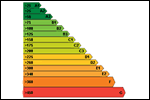
Environment Minister Phil Hogan has signed the new statutory instrument for Part L of the building regulations — which deals with energy efficiency in dwellings — into law, the department has confirmed to Construct Ireland.
The new regulations aim to deliver a 60% reduction in energy performance and carbon emissions for new dwellings compared to the 2005 standards, and will become effective from 1 December 2011.
More...
UK prepares for peak oil Dublin's derelict buildings Apple's new "spaceship"
Written by Lenny AntonelliHere's our usual round up of links that might be of interest:
To the surprise of many, Opec decides not to raise its oil production CNN
The British government appears to recognise that global oil supply will fall behind demand in the next five years Energy Bulletin
New uses for Dublin's derelict public buildings? Ireland After Nama
The Velux Sunlighthouse claims to be Austria's zero carbon and energy neutral house Inhabitat
Steve Jobs reveals Apple's plans for a new spaceship-shaped campus with lots of green space Inhabitat
Calculating the global warming impact of different insulation materials Green Building Advisor
Profile of an "affordable" passive house in Canada Green Building Advisor
An in-depth look at the deep energy retrofit of a Boston apartment block Metropolis Magazine
Can an entire house be recycled? CS Monitor

Eamon Ryan newly elected as leader of the Green Party this afternoo with 71.6% of the vote. More to follow...
Six-week consultation on green public procurement launched
Written by News Desk
The government has published its draft national action plan on green public procurement (GPP). Environment minister Phil Hogan said the plan, when finalised later this year, will apply to all personnel involved in procurement across the public sector.
The plan aims to ensure the government purchases sustainable products and services in areas such as construction, energy, food and transport.
Doubts raised over government's claims for Better Energy programme
Written by Lenny Antonelli 
SEAI's Brian Motherway (left), energy minister Pat Rabitte (centre) and the Department of Energy's Stjohn O'Connor launch the government's Better Energy upgrade programme on 11 May.
Earlier this month, energy minister Pat Rabbitte announced an "additional" €30M in government funding for building energy upgrade programmes for 2011. The government said the funds would "support an additional 2,000 jobs in 2011". These figures were reported largely without criticism in the national media. But they appear to be quite dubious, as our series of blog posts over the last few weeks has shown. Here's why:
The government claims the €30M in funding is additional to the money the previous government had committed to energy upgrades for 2011 (€60M). But the previous Fianna Fáil—Green government also announced a tax relief on home energy efficiency upgrades in Budget 2011, and this has yet to be introduced. The total value the last government pledged to fund the energy efficiency tax relief? €30M.
The tax relief will only be introduced if the minister for finance, Michael Noonan, signs a commencement order. The Department of Finance told Construct Ireland that it cannot state when or if the order will be signed. Commencement orders for budget measures sometimes remain unsigned for years — or forever.
Construct Ireland suspects the commencement order will remain unsigned, and that the €30M tax relief will quietly slip away. If we're correct, the government's claim to be putting an "additional" €30M into Better Energy is dubious. The tax relief may not have been part of that programme, but it was nonetheless an investment in making buildings more energy efficient.
We asked the Department of Communications, Energy and Natural Resources (DCENR) how the 2,000 jobs figure was calculated. It replied:
The number of jobs is derived from the additional monies allocated by the government which we know will leverage similar levels of private funding in what are labour intensive works and based upon the typical wages in the sector.
But if the money isn't really "additional", neither are the jobs. After all, the tax relief would have created jobs too. What's more, the 2,000 jobs figure does not appear to take into account potential job losses from the withdrawal of grants for heat pumps and biomass boilers — Construct Ireland is already hearing about companies losing work due to these grants being pulled.
We also emailed DCENR asking why it withdrew grants for some renewable technologies while maintaining support for oil and gas boilers, but a spokesperson did not address the question directly, and simply said:
The grant available for a new oil or gas boiler only represents a contribution to the additional cost incurred by the homeowner in choosing a high efficiency boiler (i.e. >90% efficiency) versus the standard required by the building regulations (i.e. >86% efficiency). The homeowner must also install heating controls in order to avail of the €160 subsidy.