
This is the third in a series of blog posts by the architect Mark Stephens on going off grid. The first post was a general introduction to the series, while the second focused on the building envelope.
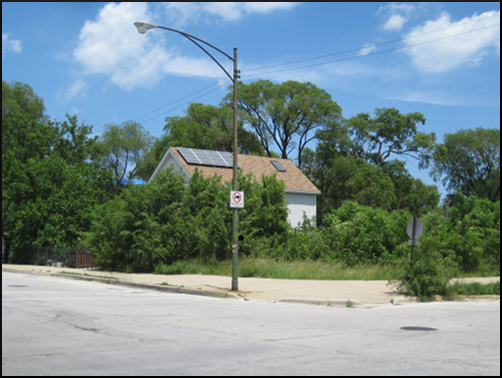
Photovoltaic (PV) panels can convert sunlight directly into electricity and are a well established way of generating off-grid power. Photo by Charlie Vinz.
The next requirement after we’ve found a suitable place to live off-grid is to provide power; we’ve already introduced the concept of going passive as a way forward in order to have minimal heat demand, but we will still need to provide power to lighting and other electrical appliances.
We can divide our power demand into two areas: 1) power for lighting/electrical items and 2) power for hot water and heating
Power for lighting/electrical items
We therefore need to generate our electricity through a self-contained, renewable method — this leaves us with three options:
Wind
The concept of micro-wind generators is well established to generate electricity; the problem is that to power a serious amount of power requires a pretty big wind turbine. But the thrust of this blog post is being more aware of our electricity consumption — we will be relying less on electrical/electronic gadgets and getting back to a more simpler life where when it gets cold we add another sweater rather than increasing the heating an extra degree. Another problem is that wind turbines are notoriously temperamental over where they are located — they won’t work as effectively in built-up urban areas and even in rural locations they require minimal obstructions that cause fluctuations and disturbances in wind speed.
Water
Again the concept of a water or hydro turbine is well established; obviously they key thing here is that you need to be next to either a fast flowing stream/river or have access to a large drop on a large body of water (head) in order to turn the hydro turbine. You will obviously need to ensure that you have a legal right to use the water.
Solar
Photovoltaic (PV) panels can convert sunlight directly into electricity and are again a well established (if costly) way of generating off-grid power. Continuing the theme of reducing our electricity consumption you can obtain a small solar panel kit that provides 150 Watts of power; the key then is to run low voltage LED lights to provide your lighting. In order to power larger items such as a standard TV that work off 240V you will need an inverter.
With all of these technologies you will come unstuck if a. there’s no wind b. the water runs dry in summer and c. there’s no sun! To get round this problem you will need a bank of batteries to store the electricity you’ve generated. The batteries will need to be quite large and ‘off-gridders’ recommend the use of submarine batteries that can store and release enough electricity for a small home. Some ‘off-gridders’ use the PV panels to charge the standard AA rechargeable batteries that are then used in LED head lamps so that you can move around after sunset without bumping into things.
Power for hot water and heating
The next form of power we will require is to provide heat for cooking, heating and hot water. As discussed, by following passive house principles we will drastically reduce our space heating requirement — a certified passive house will require less than 15 kWh/m2/yr — but we will still require hot water for showers, washing etc. A solar collector (evacuated tube or flat plate collectors for example) can provide a large percentage of your hot water requirements (60-75%), the problem occurs obviously when there is less sun during the winter months and hot water is still required. The unfortunate reality is that something will still have to be burnt in order to fulfil this shortfall. A well installed and efficient wood pellet burning stove can provide hot water and heating but the more obvious example would be a simple wood burning stove with a back boiler that can provide heating to radiators, hot water and a method of cooking food. The only draw-back is that the fire needs to be lit whenever hot water is required. Again, we need a drastic rethinking over how we live our lives and to readjust to not having a source of constant hot water. It is important to note that although wood doesn’t provide as much energy as oil or gas for example when burned (therefore you will need more of it), the CO2 emissions are over 10 x better (0.025Kg CO2 per kWh for wood compared to 0.272 CO2 per kWh for oil). The obvious place therefore to be placed to be self sufficient in wood is next to a sustainable, managed forest as Ben Law did in the Woodsman’s Cottage episode of Grand Designs.
The next guest blog post takes us onto how we become more self sufficient in terms of water and food.
As always, comments welcome.
Mark Stephens RIBA MRIAI is a UK and Ireland trained chartered architect, based in Foxford, County Mayo, Ireland. He specialises in one-off, residential houses, extensions, restorations and refurbishments. His slant is a modernist approach using traditional forms and materials; his work also combines a contemporary architecture with an ecological and sustainable soundness.
The deadline for submitting entries to the Isover Energy Efficiency Awards (EEA) has been extended until October 11.
The inaugural awards scheme is being targeted at building professionals including architects, engineers, builders and developers, across Ireland, who have worked on both new build and renovation projects with very low energy demand.
This is the second in a series of blog posts by the architect Mark Stephens on taking a traditional Irish cottage off grid. The first post is here.
OK, so here's the first main blog post - where are we going to do it? I'm going to concentrate on an actual built structure rather than the other forms of off-grid living such as yurts, camper vans etc which are discussed in Nick Rosen's excellent book How to Live Off-Grid .
The first form of structure I'll be looking at is the derelict, traditional small cottage which would have been prevalent across the whole of Ireland, though most are now are disintegrating through decay because of exposure to the elements.
There are two stages in making such a structure habitable before we even consider how we then get that dwelling off-grid:
1. Increasing the size. Although we don't want to return to the McMansion sizes of the Celtic Tiger days, we will still need to increase the floor area to make it a more practicable solution for the family of today. Normally the biggest 'traditional cottage' size would have been a single room either side of a communal eating, living/sleeping space. So unless you are a very small family you will need to increase the house by at least another bedroom, and frequently these derelict cottages were without bathrooms, so a new bathroom will also need to be included.
Some older cottages would have been even smaller — I am currently restoring two cottages that were just single rooms where entire families were raised!
I'm not going to discuss here the problems associated with planning for converting properties of this type into habitable dwellings; for more details on this visit my website .
2. Upgrading the buildings fabric to a current standard.
The standard I would suggest trying to achieve is the passive house standard, devised by the Passive House Institute in Germany. Again going into depth on this standard is beyond the scope of this blog post but we can have a look at typical insulation standards that will need to be achieved in order to get close.
The roof should be the most straightforward area as typically the roof will have to be reconstructed anew with new rafters, slates etc. This is generally because the increased weight of slating the roof (frequently the roof would have been metal sheeting that would have replaced thatch) requires the rafters to be increased in size; larger sections of timber would have been impossible to obtain when the house was originally constructed.
This means that we can create a roof with the desired level of insulation. The u-value for a certified passive house is less than 0.15 W/(m2K), which could be achieved with a warm-roof construction with sufficient insulation between the rafters, and then further insulation under them to prevent cold bridging. The amount of insulation needed will vary depending on the type used.
The walls of the cottage will be more problematic. A typical U-value for a 2' stone wall is over 2 W/m2K; to achieve 0.15W/m2K will require a rendered external insulation of around 200mm of EPS (expanded polystyrene). The good news is that cottages of this type would have been normally been rendered with a lime render and white lime wash which is not a million miles from a modern white, mono-couche external render.
As well as calculating the U-values you should also take care to avoid the risk of condensation; the correct way to do this is with a dew point graph which graphically shows the area in any construction build-up where condensation can occur. A condensation analysis can be carried out using simulation software such as WUFI, which is based on EN 15026, a European standard for simulating condensation risk.
Any new structure that extends the existing cottage will be easier to insulate to a high standard as we are constructing anew as per the roof.
The next logical step in thinking is to jump from the derelict cottages that are dotted throughout the country to the derelict houses in the ghost estates throughout every county. Theoretically they should be easier to upgrade to a better standard than the older cottages but their poor location and lack of infrastructure will remain an issue.
So, we have somewhere to live in to conduct our off-grid experiment — the next step is obtaining heat and power to the house. Trying to obtain passive house standards will drastically reduce the heat requirement for the house but it will not eliminate it entirely. The next blog post therefore will address this key aspect of off-grid living.
Consumer retrofit study, timber high rise & geothermal electricity
Written by Lenny AntonelliA quick round up of interesting stories you or may not have seen:
According to SEAI, the organisation is approving 1,000 Home Energy Saving scheme grants a week, at an average of €2,900. Press release and full report (down the bottom) are here.
Permission sought for Ireland's first geothermal energy electricity generation facility. But Richard Tol is skeptical.
Work on Dublin's Metro North to begin in April
Profile of a nine story timber-frame apartment building, including a time-lapse video showing its construction. Construct Ireland previously profiled Ireland's largest timber-frame building, the Navan Credit Union.
Beetlecrete: making use of timber that's been infested by the pine beetle.
Article and audio report on an office built out of shipping containers, which seem to be growing in popularity in the US. How long before an Irish building uses one?
Is green building causing a "real estate revolution" in the US?
Britain is banning inefficient boilers
The New York Times has an in depth feature on passive houses
The Infrastructurist asks why we (or more specifically the US, in this case) are still so afraid of nuclear power?
Some cool aerial photos of urban sprawl in the US (they're after the first few aerial photos of prisons)
The world's biggest offshore windfarm has been activated in the North Sea
1,000 home energy upgrade grants awarded each week
Written by Lenny AntonelliMore than a thousand applications for Home Energy Savings (HES) scheme grants are being approved every week and 98.5% percent of recipients say they would recommend the scheme to others, according to the Sustainable Energy Authority of Ireland (SEAI). The survey also revealed that over 68,000 grants have been awarded since the scheme began in April 2009.
Green building seminars, Ireland's land banks & more
Written by Lenny AntonelliIn May we profiled the Nottingham House, an entry into Solar Decathlon Europe designed by a team from the University of Nottingham that featured an insulation system from Isover Ireland. The Solar Decathlon challenges university teams to design and build homes that maximise the sun's energy. This was the first year of the European competition - the US version is well established.
Anyway, here's a video from the University of Nottingham documenting the build process.
[video:tp://www.youtube.com/watch?v=KP6vQnATckk]
New Irish passive house association launched in Dublin
Written by News Desk

People planning to build a new home could save themselves thousands of
euro each year by developing a passive house, according to the Passive
House Association of Ireland (PHAI), a new low energy design initiative
comprising passive house designers and contractors.
Getting the most from your heat pump, healthy buildings & first US passive retrofit
Written by Lenny AntonelliHi everyone, the new issue of CI has gone to print and should be out by early next week. Having just caught up on what's been happening in the green building and energy world for the first time in a few weeks, here's some stories that caught my eye.
How to get the most from your heat pump: Treehugger
Fascinating profile of Honk Kong's rooftop villages: Sustainable Cities Collective
Top ten green building prioties: No 10, make it easy: Green Building Advisor
Green buildings may boost occupants' health and productivity: Green Building Advisor
The US's first certified passive house retrofit: Green Building Advisor (more here
San Francisco unveils striking-solar powered stadium: Inhabitat
Report questions whether rainwater and greywater harvesting are really green: Energy Saving Trust
Should building regulations be less impenetrable and more consumer-friendly? Energy saving Trust
Paris to heat buildings using metro: Guardian
Profile of Britain's first recycled theatre: Guardian
More...
The architect Mark Stephens begins a series of guest blog posts on going off grid
Welcome to this first in a series of guest blog posts that came about following the many enquiries and questions I receive as part of my everyday work and through the Ask the Architect service. This particular question came from Sylas Harper with the basic premise being that people haven’t got much money at the moment but they still need somewhere to live, and that throughout the country there are derelict houses that could be turned into homes. What I’m talking about here is living off-grid — a home that is not connected to mains electricity, water, gas or sewage. A home that is self-sufficient, sustainable and lowers the demands placed upon the planet. Once the enclave of the hippy or the hermit; the concepts behind living off-grid are now completely mainstream; solar panels and wind turbines are now commonplace and it is essential that we look for ways to lower our carbon dioxide emissions and to live a more sustainable life. As a theoretical experiment it may not be possible to adopt all of the points I’ll raise, but some of the aspects could be adopted by anyone seeking a more ecologically aware existence.
Now the initial question was posed thinking of the traditional Irish cottage wrecks dotted throughout the country, but with the recent news on the ghost estates throughout Ireland I came to the opinion that these ghost estates are the modern day equivalent of the derelict homes left to rot and be visible for generations to come. Surely there’s some way of getting ghost estates back into the hands of the ones that should be owning them - ie the people - especially now that all these homes are now effectively owned by the Irish tax payer via Nama. The Irish cottage concept is equally valid, and the points raised in these guest blog posts will equally apply to all types of housing.
Maybe it’s too big a jump to ask to get these ghost estates occupied and in-use? The argument could be made that living off-grid is possible for a sole dwelling but for an entire community of people? Well, Nick Rosen in his excellent book How to Live Off-Grid (ISBN:978-0-553-81819-2) discusses thoroughly the arguments and concepts for off-grid living and through his off-grid journey meets individuals and entire communities living beyond the constraint of national services. I cannot recommend this book highly enough — if you’re interested in off-grid living in any way, buy it now!
So what are we talking about here? We basically have four facets to living off-grid:
1. WHERE
We need somewhere to do it; that is an enclosure that gives us protection and shelter from the elements; a defendable space that we can call our own - a private space to retreat to and a public space to interact with others.
This will be the argument behind the first main blog post — I’ll be looking at what you will need to look for to provide your ideal off-grid dwelling. This blog post will also incorporate passive house concepts; a dwelling adhering to passive house concepts (airtightness, high levels of insulation etc) will obviously require less energy to heat than a more conventional house.
2. POWER
We will need to provide power to the houses without relying on the national grid. It’s too much to ask people to live in houses powered by candles, to go to bed as soon as it gets dark or wander around your house with LED lamps strapped to the head. The dwellings will need to be powered in a reliable yet sustainable way.
Therefore, the concept of this second blog post will be investigating methods of providing enough energy to adequately provide light and heat to the house and providing hot water for baths and showers.
3. WATER & FOOD
Each dwelling will also require a potable water supply, and the third blog post will investigate what will be required to bring water to a site with no discernible, potable water supply. I will be looking at methods of extracting water from the ground (wells) and water harvesting/purification to provide water for drinking as well as the ‘grey’ water for flushing toilets etc. I’ll also be taking a little detour to see how any land associated with the dwelling (or even communal land) can be used to grow vegetables/fruit and again contribute to a more sustainable and self-sufficient life.
4. EFFLUENT
Each dwelling will need to safely dispose of its effluent; this will probably be the biggest problem (as evidenced by the current strict
standards regarding obtaining planning permissions involving a new septic tank). But equally this theoretically should be the easiest problem to solve as Ireland doesn’t have a national sewage infrastructure and the use of individual septic tanks and effluent treatment units is well established (ground conditions permitting). I’ll also be looking at composting toilets and reed bed systems.
The plan is to do one of these guest blog posts every week, so hold onto your hats for an interesting ride and a theoretical experiment in off-grid living with the first blog-post looking at where we are going to do it.
Comments welcome.
Mark Stephens RIBA MRIAI is a UK and Ireland trained chartered architect, based in Foxford, County Mayo, Ireland. He specialises in one-off, residential houses, extensions, restorations and refurbishments. His slant is a modernist approach using traditional forms and materials; his work also combines a contemporary architecture with an ecological and sustainable soundness.
Plan to energy upgrade one million buildings launched
Written by Lenny Antonelli
One million residential, public and commercial buildings in Ireland will get energy upgrades by 2020 under the latest national retrofit strategy. A consultation was launched this morning on the plan, which will aim to deliver 8,000 GWh of energy savings between 2011 and 2020.
RIAI host one day course on home energy upgrades
Written by News Desk
The RIAI, in partnership with Joseph Little Architects, has announced the launch of an intensive one day programme on home energy upgrades designed specifically for architectural professionals. The course will be delivered through lectures and workshops.
The energy efficiency pyramid, urban planning successes & vertical farming
Written by Lenny AntonelliSorry for the slow stream of blog posts recently, I've been out of the office a lot. I spent yesterday looking at some innovative home systems for dealing with wastewater in Dundalk, and I'll try to blog about that soon. But for now, here's a bumper bunch of links.
Interesting profile of a small Welsh town designed in 1925 with some green principles in mind: Sustainable Cities Collective
Vapour profiles help predict whether a wall can dry: Green Building Advisor
The pyramid of energy efficiency — is this a useful tool for approach energy upgrades? Treehugger
How Britain's homes could make cost free emissions cuts: Guardian
Insightful interview with renowned green architect William McDonough on "cradle-to-cradle" design: Forbes
Improving the energy efficiency of buildings — IIEA conference in Dublin, Sept 3. IIEA
London's new "green" Strata tower named ugliest building in Britain: Treehugger
If the grid didn't exist, would there still be a need to invent it? Infrastructurist
Top 20 urban planning successes of all time: Public Servant Blog
Some vertical farms could actually get built says the SSC. George Monbiot, writing in the Guardian, thinks it's an absurd idea.
RIAI course on designing low energy retrofit in association with Joseph Little Architects: RIAI
Profile of a pay-as-you-save scheme in the UK: Guardian